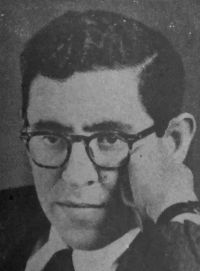
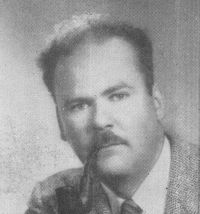
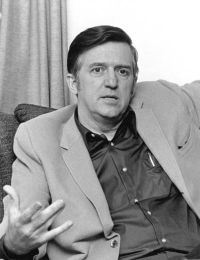
Edward W. Ludwig

Biographical details

Edward W. Ludwig A Coffin for Jacob

The dust was master. The dome, Ben felt, was as transitory as a tear-drop of fragile glass falling down, down, to crash upon stone.
"Is it always like this?" he asked. "Doesn't the wind ever stop?"
"Sometimes the wind dies. Sometimes, at night, you can see the lights from the city."
He kept staring. The dome, he thought, was a symbol of Man's littleness in a hostile universe.
But, too, it was a symbol of his courage and defiance. And perhaps Man's greatest strength lay in the very audacity that drove him to build such domes.
"You like it, don't you?" Maggie asked.
Source: Gutenberg

Edward W. Ludwig The Lonely Ones

No life there. Not even the stars to make one think of home. Only the dust and wind, a dark veil of death screaming eternally over hot dry land.
And Jupiter, with its seas of ice; and hot Mercury, a cracked, withered mummy of a planet, baked as hard and dry as an ancient walnut in a furnace.
Next, the airless, rocky asteroids, and frozen Saturn with its swirling ammonia snows. And last, the white, silent worlds, Uranus, Neptune, and Pluto.
World after world, all dead, with no sign of life, no reminder of life, and no promise of life.
Thus the loneliness had grown. It was not a child of Earth.
Source: Gutenberg

Edward W. Ludwig To Save Earth

There had been times when all of them—mad and near-mad—had forgotten that they hurtled through space, that they were men and that they were growing old. Occasionally they had even forgotten that the destiny of mankind might lie in their hands like a fragile flower to be preserved or crushed.
But now came a moment six years one month and five days after their departure from Earth. The sole planet of Sirius loomed green and blue in the ship's magni-screen. The sight of the shining planet was like a heavenly trumpet call, a signal for resurrection.
Source: Gutenberg

Get perspective with Kwize: daily news enlightened by great literature