“ Hardly had man solved his basic problems on the planet of his origin than he began to fumble into space. Barely a century had elapsed in the exploration of the Solar System than he began to grope for the stars.And suddenly, with an all but religious zeal, mankind conceived its fantasy dream of populating the galaxy. Never in the history of the race had fervor reached such a peak and held so long. The question of why was seemingly ignored. Millions of Earth-type planets beckoned and with a lemming-like desperation humanity erupted into them. ”
Mack Reynolds
Biographical details

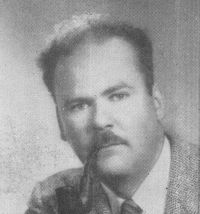
Dallas McCord "Mack" Reynolds (1917–1983) was an American science fiction writer renowned for his radical socioeconomic speculation and critiques of capitalist systems. Writing under pseudonyms such as Clark Collins and Maxine Reynolds, he explored utopian societies, technocratic governance, and post-capitalist futures through works like Black Man's Burden and Adaptation.
His novels often contrasted idealistic visions with dystopian realities, examining themes of automation, global governance, and class struggle. Reynolds’s speculative forecasts—ranging from universal basic income to global computer networks—resonated with readers and anticipated contemporary socio-technological trends, cementing his legacy as a visionary voice in 20th-century science fiction.
Quotes by Mack Reynolds
 Mack Reynolds,
The Cosmic Bluff
Mack Reynolds,
The Cosmic Bluff
“ And then, just as the Centaurian headed for me again, it clicked.A silence had settled down over the crowd. Arena wise, through years of watching gladiatorial events, they knew my knees were sagging, my reflexes slowed, my muscles screaming protest.I stood there, sword in hand, directly in its path—waiting. It had said, "You can't fool me all of the time, Terran."And that's what had clicked.You can fool some of the people some of the time....Praying that I had strength enough left for this, I waited until it was nearly upon me, its lobster claws out-thrust, its six heavy feet pounding. ”
“ Joe Mauser and Max Mainz strolled the streets of Kingston in an extreme of atmosphere seldom to be enjoyed. Not only was the advent of a divisional magnitude fracas only a short period away, but the freedom of an election day as well. The carnival, the Mardi Gras, the fete, the fiesta, of an election. Election Day, when each aristocrat became only a man, and each man an aristocrat, free of all society's artificially conceived, caste-perpetuating rituals and taboos. ”