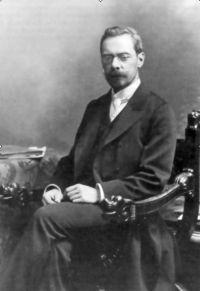
Franz Thonner

Biographical details

Portrait of Franz Thonner Franz Thonner,  The flowering plants of Africa (1915)

“ As the present work is intended for the use not only of botanists, but also of colonists and travellers in Africa, who take an interest in botany, I have used, wherever it was possible, as distinctive characters, those which are visible to the naked eye in a plant in flower, being careful, however, not to deviate too much from the natural system. ”
Source: Gutenberg

Portrait of Franz Thonner Franz Thonner,  The flowering plants of Africa (1915)

“ Succulent herbs without green colour, parasitic on roots, upon which their root-stock is seated. Leaves reduced to scales. Flowers in spadix-like spikes or heads, red, unisexual. Perianth in the male flowers of 3-6 segments, in the female 3-lobed or wanting. Stamens as many as and opposite the perianth-segments, sometimes one of them abortive. Ovary inferior or naked, 1-celled. Ovules 1-3, pendulous from a central placenta or from the apex of the cell or adnate to the wall of the ovary, without coats. Style simple, sometimes very short; stigma entire or lobed. ”
Source: Gutenberg

Portrait of Franz Thonner Franz Thonner,  The flowering plants of Africa (1915)

“ Epicalyx (epicalyx) . A whorl of bracts closely surrounding a flower and resembling an outer calyx.
Epicarp (epicarpium) . The outermost layer of the pericarp.
Epigynous (epigynus) . Inserted at the upper edge of a concave receptacle which is united with the ovary.
Epiphyte (epiphyticus) . Growing upon other plants without deriving nourishment from them.
Ex- (ex-) . Without. Exalbuminous = without albumen. Exstipulate = without stipules.
Exocarp (exocarpium) . The outermost layer of the pericarp.
Exserted (exsertus) . Projecting beyond the tube of the perianth or corolla.
”
Source: Gutenberg

Get perspective with Kwize: daily news enlightened by great literature