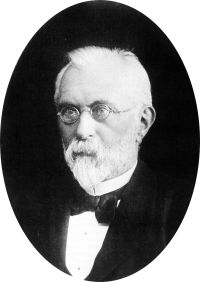
Alfred Barton Rendle

Biographical details

Alfred Barton Rendle,  1911 Encyclopædia Britannica (1911)

“ When the fruit is composed of the ovaries of several flowers united, it is usual to find the bracts and floral envelopes also joined with them, so as to form one mass; hence such fruits are known as multiple, confluent or anthocarpous. The term simple is applied to fruits which are formed by the ovary of a single flower, whether they are composed of one or several carpels, and whether these carpels are separate or combined.
The object of the fruit in the economy of the plant is the protection and nursing of the developing seed and the dispersion of the ripe seeds.
”
Source: Wikisource

Alfred Barton Rendle,  1911 Encyclopædia Britannica, Volume 4… (1911)

“ It takes a comprehensive view of all the plants which cover the earth, from the minutest organism, only visible by the aid of the microscope, to the most gigantic productions of the tropics. It marks the relations which subsist between all members of the plant world, including those between existing groups and those which are known only from their fossilized remains preserved in the rocks. We deal here with the history and evolution of the science. ”
Source: Wikisource

Alfred Barton Rendle,  1911 Encyclopædia Britannica (1911)

“ Flowers are produced from flower-buds, just as leaf-shoots arise from leaf-buds. These two kinds of buds have a resemblance to each other as regards the arrangement and the development of their parts; and it sometimes happens, from injury and other causes, that the part of the axis which, in ordinary cases, would produce a leaf-bud, gives origin to a flower-bud. A flower-bud has not in ordinary circumstances any power of extension by the continuous development of its apex. ”
Source: Wikisource

Get perspective with Kwize: daily news enlightened by great literature