Georg Cantor

Biographical details

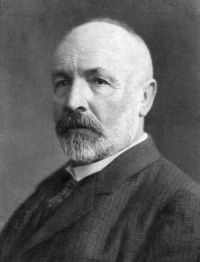
Portrait of Georg Cantor Georg Cantor Contributions to the Founding of the Theory of Transfinite Numbers (1915)

The ordinal types of finite ordered aggregates offer no special interest. For we easily convince ourselves that, for one and the same finite cardinal number , all simply ordered aggregates are similar to one another, and thus have one and the same type. Thus the finite simple ordinal types are subject to the same laws as the finite cardinal numbers, and it is allowable to use the same signs for them, although they are conceptually different from the cardinal numbers.
Source: Wikisource

Portrait of Georg Cantor Georg Cantor Contributions to the Founding of the Theory of Transfinite Numbers (1915)

We will call by the name "part" or "partial aggregate" of an aggregate any other aggregate whose elements are also elements of .
If is a part of and is a part of , then is a part of .
Every aggregate has a definite "power," which we will also call its "cardinal number."
We will call by the name "power" or "cardinal number" of the general concept which, by means of our active faculty of thought, arises from the aggregate when we make abstraction of the nature of its various elements and of the order in which they are given.
Source: Wikisource

Portrait of Georg Cantor Georg Cantor Contributions to the Founding of the Theory of Transfinite Numbers (1915)

After Veronese has, so to speak, given up of his own free will the indispensable foundation for the comparison of numbers, we ought not to be surprised at the lawlessness with which, later on, he operates with his pseudo-transfinite numbers, and ascribes properties to them which they cannot possess simply because they themselves, in the form imagined by him, have no existence except on paper.
Source: Wikisource

Get perspective with Kwize: daily news enlightened by great literature