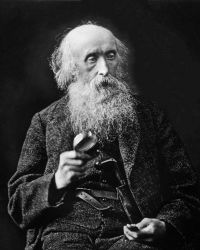
John Hutton Balfour

Biographical details

Portrait of John Hutton Balfour John Hutton Balfour Obituary notice of Charles Robert Darwin (1882)

He was a naturalist of great observation, and continued to study natural phenomena during his whole life. His theory of progressive development has received much attention and has given rise to much discussion. As Mr Spottiswoode remarked before the Royal Society, he lived to a good old age, to see the work of his life enthusiastically recognised.
Darwin was highly prized, not only as a physiological botanist, but as an excellent cultivator.
Source: Wikisource

Portrait of John Hutton Balfour John Hutton Balfour Obituary notice of Charles Robert Darwin (1882)

After a long lull in publications, Darwin gave to the world, in 1867 [actually 1859] , his Origin of Species, which has given rise to so much discussion. This was followed by numerous monographs, many of them specially botanical, such as On the Fertilisation of Orchids, The Habits of Climbing Plants, Insectivorous Plants, &c. His published writings have been circulated far and wide, and have been translated into various languages.
Darwin was certainly one of the greatest naturalists
Source: Wikisource

Portrait of John Hutton Balfour John Hutton Balfour Obituary notice of Charles Robert Darwin (1882)

It does not absolutely follow, in making a cross between distinct species, that the same rule would follow in the fertility of the pollen. I hope that you will try and mark separately (excluding insects, as you know better than I do the necessity) , the two kinds of pollen of one species on the stigma of the other, and see in making hybrids what the difference is in fertility, and in the character of the hybrid seedlings.
"This would be an entirely new field for observation and discovery. You will see in my paper that some species of Linum are not dimorphic, and are self-fertile
Source: Wikisource

Get perspective with Kwize: daily news enlightened by great literature