“ The lark's is the lyrical genius; the nightingale's, the epic, the drama, the inner struggle,—from thence, a light apart. In deep darkness, it looks into its soul, into love; soaring at times, it would seem, beyond the individual love into the ocean of love infinite.And will you not call him an artist? He has the artist's temperament, and exalted to a degree which man himself rarely attains. All which belongs to it—all its merits, all its defects—in him are superabundant. He is mild and timid, mistrustful, but not at all cunning. He takes no heed to his safety, and travels alone. ”
Jules Michelet
Biographical details

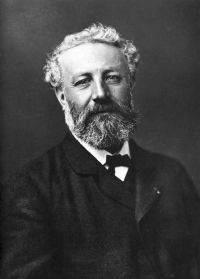
Jules Michelet (1798–1874), a French historian and Romantic writer, is renowned for his monumental Histoire de France, which redefined national historiography by focusing on ordinary people and their customs. Influenced by Giambattista Vico’s cyclical view of history, Michelet coined the term Renaissance to signify Europe’s cultural revival after the Middle Ages, shaping modern interpretations of the period.
His works, such as Priests, Women, and Families and The Sea, explore themes of freedom versus destiny, humanism, and the vitality of nature. A dedicated republican and critic of power, Michelet’s legacy lies in his poetic yet rigorous historiography, which remains foundational to understanding 19th-century revolutionary thought.
Quotes by Jules Michelet
 Jules Michelet,
The Sea (La Mer)
Jules Michelet,
The Sea (La Mer)
“ In its semi-transparent density, the sea has its own lucidity, its own glowing gleam, like that which fish, living or dead, reflect. The Sea! glorious Sea, hath her own lights, her own Sun, Moon, and Stars.Gaze inquisitively and intelligently on a mere salt well and you at once perceive how prolific the ocean depths must be; that seeming deposit of dead and inert matter hath its real life; it is a mass of infusoriæ, microscopic, but organized and sentient. All voyagers on the wide Ocean concur in telling us that in their far wanderings they still and ever traverse living waters. ”
Jules Michelet,
La Sorcière: The Witch of the Middle Ages
“ Ay, have I not been sadly slandered? ’Tis I who alone can make them reappear; a boon untold, for which I surely deserved an altar.”To pierce the future and to call up the past, to forestal and to live again the swift-flying moments, to enlarge the present with that which has been and that which will be—these are the two things forbidden to the Middle Ages; but forbidden in vain. Nature is invincible; nothing can be gained in such a quarter. He who thus errs is a man. It is not for him to be rooted to his furrow, with eyes cast down, looking nowhere beyond the steps he takes behind his oxen. ”