“ When Atropos the lovely Lovelace hit! How th' active fire, which cloath'd thy gen'rous mind, Consum'd the water, and the earth calcin'd Untill a stronger heat by death was given, Which sublimated thy poor soul to heaven. Thou knew'st right well to guide the warlike steed, And yet could'st court the Muses with full speed And such success, that the inspiring Nine Have fill'd their Thespian fountain so with brine. Henceforth we can expect no lyrick lay, But biting satyres through the world must stray. ”
Richard Lovelace
Biographical details

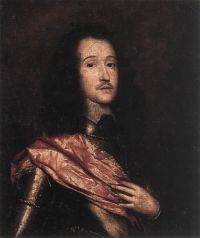
Richard Lovelace (1617–1658), an English poet and royalist, rose to prominence among the Cavalier poets of the 17th century. His writings, shaped by his military service for Charles I and later confinement, delve into themes of honor, affection, and the conflict between personal loyalty and political obligation.
Most celebrated for "To Althea, from Prison" and "To Lucasta, Going to the Warres," Lovelace’s verse blends lyrical grace with the upheaval of his time, culminating in the posthumous compilation Lucasta, which enshrines his muse and highlights his dual identity as both a warrior and a literary pioneer.
Quotes by Richard Lovelace
“ Himself and 's manners both do pay you rent, And 'bout your house (your pallace) doth resort, And 'spite of fate and war creates a court. So from the taught north, when you shall return, To glad those looks that ever since did mourn, When men uncloathed of themselves you'l see, Then start new made, fit, what they ought to be; Hast! hast! you, that your eyes on rare sights feed: For thus the golden triumph is decreed. The twice-born god, still gay and ever young, With ivie crown'd, first leads the glorious throng: He Ariadne's starry coronet Designs for th' brighter beams of Amoret ”
 Richard Lovelace,
To Chloe, Courting her for his Friend
Richard Lovelace,
To Chloe, Courting her for his Friend
“ And I being Sun within thy Sphere, 'Tis my chiefe beauty thinner lights shine there. III The Us'rer heaps unto his store, By seeing others praise it more; Who not for gaine, or want doth covet, But 'cause another loves, doth love it: Thus gluttons cloy'd afresh invite Their Gusts, from some new appetite; And after cloth remov'd, and meate, Fall too againe by seeing others eate. ”
Richard Lovelace,
An Elegy. On the Death of Mrs. Cassandra Cotton
“ Enter the dismall chancell of this roome, Where each pale guest stands fixt a living tombe ; With trembling hands helpe to remove this earth To its last death and first victorious birth : Let gums and incense fume, who are at strife To enter th' hearse and breath in it new life ; Mingle your steppes with flowers as you goe, Which, as they haste to fade, will speake your woe. ”
Richard Lovelace,
To Lucasta, Going Beyond the Seas
“ IF to be absent were to be Away from thee; Or that when I am gone, You or I were alone; Then my Lucasta might I crave Pity from blustring winde, or swallowing wave. ”
“ ELEGIES. TO THE MEMORY OF MY WORTHY FRIEND COLL. RICHARD LOVELACE.<108.1> To pay my love to thee, and pay it so, As honest men should what they justly owe, Were to write better of thy life, then can The assured'st pen of the most worthy man. Such was thy composition, such thy mind, Improv'd from vertue, and from vice refin'd; Thy youth an abstract of the world's best parts, Invr'd to arms and exercis'd to arts, Which, with the vigour of a man, became Thine and thy countries piramids of fame. Two glorious lights to guide our hopeful youth Into the paths of honour and of truth. ”
Richard Lovelace,
An Elegy. On the Death of Mrs. Cassandra Cotton
“ III. Dare to affect a serious holy sorrow, To which delights of pallaces are narrow, And, lasting as their smiles, dig you a roome, Where practise the probation of your tombe With ever-bended knees and piercing pray'r, Smooth the rough passe through craggy earth to ay'r ; Flame there as lights that shipwrackt mariners May put in safely, and secure their feares, Who, adding to your joyes, now owe you theirs. ”
Richard Lovelace,
The Hundred Best Poems
(1904)
“ Our careless heads with roses crown'd Our hearts with loyal flames; When thirsty grief in wine we steep, When healths and draughts go tree Fishes that tipple in the deep Know no such liberty. ”
“ II. Through foule, we follow faire, For had the World one face And Earth been bright as Ayre, We had knowne neither place; Indians smell not their Neast: A Swisse or Finne tastes best, The Spices of the East. III. So from the glorious Sunne, Who to his height hath got, With what delight we runne To some black Cave, or Grot! And Heav'nly Sydney you Twice read, had rather view Some odde Romance, so new. IV. The God that constant keepes Unto his Dieties, Is poore in Joyes, and sleepes Imprison'd in the skies: This knew the wisest, who From Juno stole, below To love a Beare, or Cow. ”
“ Lovelace had not the melodious and exquisite taste of Herrick, the wit of Suckling, or the power of Randolph (so often second only to his master Jonson) . Mr. Singer has praised the exuberant fancy of Lovelace; but, in my thinking, Lovelace was inferior in fancy, as well as in grace, both to Carew and the author of HESPERIDES. Yet Lovelace has left behind him one or two things, which I doubt if any of those writers could have produced, and which our greatest poets would not have been ashamed to own. ”
Richard Lovelace,
Gratiana Dancing and Singing
“ III. Each step trod out a lovers thought And the ambitious hopes he brought, Chain'd to her brave feet with such arts, Such sweet command and gentle awe, As when she ceas'd, we sighing saw The floore lay pav'd with broken hearts.IV. So did she move: so did she sing: Like the harmonious spheres that bring Unto their rounds their musick's ayd ”
Richard Lovelace,
Ode. To Lucasta. The Rose.
“ Haste to adorn her Bower : From thy long clowdy bed, Shoot forth thy damaske head.II. New-startled blush of Flora ! The griefe of pale Aurora, Who will contest no more ; Haste, haste, to strowe her floore. ”
“ TO HIS NOBLE FRIEND CAPT. DUDLEY LOVELACE UPON HIS EDITION OF HIS BROTHERS POEMS. Thy pious hand, planting fraternal bayes, Deserving is of most egregious praise; Since 'tis the organ doth to us convey From a descended sun so bright a ray. ”
Richard Lovelace,
Song. To Amarantha, That she would dishevel her hair
“ Like the Sun in's early ray, But shake your head and scatter day. V See 'tis broke! Within this Grove The Bower, and the walkes of Love, Weary lye we downe and rest, And fanne each others panting breast. ”
Richard Lovelace,
To Lucasta, Going Beyond the Seas
“ Unseene, unknowne, and greet as Angels greet.IV. So then we doe anticipate Our after-fate, And are alive i' th' skies, If thus our lips and eyes Can speake like spirits unconfin'd In Heav'n, their earthy bodies left behind. ”
Richard Lovelace,
The Hundred Best Poems
(1904)
“ When I lie tangled in her hair And fetter'd to her eye, The birds that wanton in the air Know no such liberty. ”
Richard Lovelace,
An Elegy. On the Death of Mrs. Cassandra Cotton
“ If not to dye, dare but to live like her : Dare to live virgins, till the honour'd age Of thrice fifteen cals matrons on the stage, Whilst not a blemish or least staine is scene On your white roabe 'twixt fifty and fifteene ”
“ A mercer now by th' yard does measure ore An ode, which was but by the foot before; Deals you an ell of epigram, and swears It is the strongest and the finest wears. No wonder, if a drawer verses rack, If 'tis not his, 't may be the spir't of sack; Whilst the fair bar-maid stroaks the muses teat, For milk to make the posset up compleat. ”
“ TO HIS MUCH HONOURED FRIEND, MR. RICHARD LOVELACE, ON HIS POEMS. He that doth paint the beauties of your verse, Must use your pensil, be polite, soft, terse; Forgive that man whose best of art is love, If he no equall master to you prove. ”
“ You wrong'd in her the Houses priviledge; Some that you under sequestration are, Because you write when going to the Warre; And one the book prohibits, because Kent Their first Petition by the Authour sent. But when the beauteous ladies came to know, That their deare Lovelace was endanger'd so: Lovelace, that thaw'd the most congealed brest, He who lov'd best, and them defended best, Whose hand so rudely grasps the steely brand, Whose hand so gently melts the ladies hand, They all in mutiny, though yet undrest, Sally'd, and would in his defence contest. ”
Richard Lovelace,
The Hundred Best Poems
(1904)
“ Fishes that tipple in the deep Know no such liberty. ”
“ ON THE BEST, LAST, AND ONLY REMAINING COMEDY OF MR. FLETCHER. THE WILD GOOSE CHASE.<92.1> I'm un-ore-clowded, too! free from the mist! The blind and late Heaven's-eyes great Occulist, Obscured with the false fires of his sceme, Not half those souls are lightned by this theme. Unhappy murmurers, that still repine (After th' Eclipse our Sun doth brighter shine) , Recant your false grief, and your true joys know; Your blisse is endlesse, as you fear'd your woe! What fort'nate flood is this! what storm of wit! Oh, who would live, and not ore-whelm'd in it? ”
“ TO HIS NOBLE FRIEND, MR. RICHARD LOVELACE, UPON HIS POEMS. SIR, Ovr times are much degenerate from those, Which your sweet Muse, which your fair fortune chose; And as complexions alter with the climes, Our wits have drawne th' infection of our times. That candid age no other way could tell To be ingenious, but by speaking well. Who best could prayse, had then the greatest prayse; 'Twas more esteemd to give then wear the bayes. Modest ambition studi'd only then To honour not her selfe, but worthy men. ”
“ Did I pronounce him dead! no, no! he lives, And from his aromatique cell he gives Spice-breathed fumes, whose odoriferous scent (In zephre-gales which never can be spent) Doth spread it self abroad, and much out-vies The eastern bird in her self-sacrifice; Or Father Phoebus, who to th' world derives Such various and such multiformed lives, Took notice that brave Lovelace did inspire The universe with his Promethean fire, And snatcht him hence, before his thread was spun, En'ving that here should be another Sun. T. L.<113.1><113.1> Thomas Lovelace, one of the poet's brothers. ”
“ Saw'st and dislik'st its vaine pompe, then didst flye Up for eternall glories to the skye? Like a religious ambitious one, Aspiredst for the everlasting crowne? Ah! holy traytour to your brother prince, Rob'd of his birth-right and preheminence! Could you ascend yon' chaire of state e're him, And snatch from th' heire the starry diadem? Making your honours now as much uneven, As gods on earth are lesse then saints in heav'n. Triumph! sing triumphs, then! Oh, put on all Your richest lookes, drest for this festivall! ”
“ Twist their soft beams like these in their chast air? As from bright numberlesse imbracing rayes Are sprung th' industrious dayes, So when they gaze, And change their fertile eyes with the new morn, A beauteous offspring is shot forth, not born. ”
“ Your self you have a good physician shown To his much grieved friends and to your own, In giving this elixir'd medecine, For greatest grief a soveraign anodine. Sir, from your Brother y' have convey'd us bliss; Now, since your genius so concurs with his, Let your own quill our next enjoyments frame; All must be rich, that's grac'd with Lovelace name. ”
“ LOVELACE, I offer at thy honour'd tomb. And though thy vertues many friends have bred To love thee liveing, and lament thee dead, In characters far better couch'd then these, Mine will not blott thy fame, nor theirs encrease. 'Twas by thine own great merits rais'd so high, That, maugre time and fate, it shall not dye. Sic flevit. Charles Cotton.<108.1> These lines may be found, with some verbal variations, in the poems of Charles Cotton, 1689, p. 481-2-3. ”
“ His SCHOLLARS school'd, sayd if he had been wise He should have wove in one two COMEDIES; The first for th' gallery, in which the throne To their amazement should descend alone, The rosin-lightning flash, and monster spire Squibs, and words hotter then his fire. Th' other for the gentlemen oth' pit, Like to themselves, all spirit, fancy, wit, In which plots should be subtile as a flame, Disguises would make PROTEUS stil the same: Humours so rarely humour'd and exprest, That ev'n they should thinke 'em so, not drest ”
“ Those who have any acquaintance with the history of early English music need not to be informed that it was formerly the practice of our own composers to seek the patronage of the gentlemen and ladies about the Court for their works, and to identify their names with them. ”
“ Fair as original light first from the chaos shot, When day in virgin-beams triumph'd, and night was not, And as that breath infus'd in the new-breather good, When ill unknown was dumb, and bad not understood; Chearful, as that aspect at this world's finishing, When cherubims clapp'd wings, and th' sons of Heaven did sing; Chast as th' Arabian bird, who all the ayr denyes,<79.1> And ev'n in flames expires, when with her selfe she lyes. Oh! she's as kind as drops of new faln April showers, That on each gentle breast spring fresh perfuming flowers; She's constant, gen'rous, fixt ”
“ Johanna. ! of the Earls of Leicester. ! ——————————————————- ! ! ! ! Richard. Ciriac. . . . . . . . .The above has been partly derived from a communication to the GENTLEMAN'S MAGAZINE for Dec. 1791, by Sir Egerton Brydges, who chiefly compiled it from Hasted, compared with Berry's KENT GENEALOGIES, 474, where there are a few inaccuracies. It is, of course, a mere skeleton-tree, and furnishes no information as to the collateral branches, the connexion between the houses of Stanley and Lovelace, &c. ”
“ If I have freedome in my love, And in my soule am free, Angels alone that sore above Enjoy such liberty. ”
“ In 1636, when the king and queen were for some days entertained at Oxon, he was, at the request of a great lady belonging to the queen, made to the Archbishop of Canterbury [Laud] , then Chancellor of the University, actually created, among other persons of quality, Master of Arts, though but of two years' standing; at which time his conversation being made public, and consequently his ingenuity and generous soul discovered, he became as much admired by the male, as before by the female, sex. ”
“ It was a very usual practice (then even more so than now) among familiar acquaintances to use the abbreviated Christian name in addressing each other; thus Suckling was JACK; Davenant, WILL; Carew, TOM, &c.; in the preceding generation Marlowe had been KIT; Jonson, BEN; Greene, ROBIN, and so forth; and although there is no positive proof that Lovelace and Suckling were intimate, it is extremely probable that such was the case, more especially as they were not only brother poets, but both country gentlemen belonging to neighbouring counties. ”
“ Few readers require to be told that anagrams and acrostics were formerly one of the most fashionable species of composition. Lovelace here pictures a poetaster "stewing" his brains with a poem of this description, which of course demanded a certain amount of tedious and minute attention to the arrangement of the name of the individual to whom the anagram or acrostic was to be addressed, and this was especially the case, where the writer contemplated a DOUBLE acrostic. ”
“ Lovelace hath long been dead, and he<111.2> can be Oblig'd to no man for an elegie. Are you all turn'd to silence, or did he Retain the only sap of poesie, That kept all branches living? must his fall Set an eternal period upon all? So when a spring-tide doth begin to fly<111.3> From the green shoar, each neighbouring creek grows dry. But why do I so pettishly detract An age that is so perfect, so exact? In all things excellent, it is a fame Or glory to deceased Lovelace name: For he is weak in wit, who doth deprave Anothers worth to make his own seem brave ”
“ When beauty once thy vertuous paint hath on, Age needs not call her to vermilion; Her beams nere shed or change like th' hair of day,<88.11> She scatters fresh her everlasting ray. Nay, from her ashes her fair virgin fire Ascends, that doth new massacres conspire, Whilst we wipe off the num'rous score of years, And do behold our grandsire [s] as our peers; With the first father of our house compare We do the features of our new-born heir: For though each coppied a son, they all Meet in thy first and true original. ”
“ Parliamentary literature has not a very strong fascination for the editors of old authors, and the biographers of Lovelace have uniformly overlooked the mine of information which lies in the LORDS' AND COMMONS' JOURNALS. The subject was apparently introduced, for the first time, into Parliament on the 28th March, 1642, when a conference of both Houses took place, respecting "a petition from Kent, which, praying for a Restoration of the Bishops, Liturgy and Common Prayer, and other constitutional measures, was voted seditious and against privilege and the peace of the kingdom;" ”
“ You that do suck for thirst your black quil's blood,<90.6> And chaw your labour'd papers for your food, I will inform you how and what to praise, Then skin y' in satin as young Lovelace plaies. Beware, as you would your fierce guests, your lice, To strip the cloath of gold from cherish'd vice; Rather stand off with awe and reverend fear, Hang a poetick pendant in her ear, Court her as her adorers do their glasse, Though that as much of a true substance has, Whilst all the gall from your wild<90.7> ink you drain, The beauteous sweets of vertues cheeks to stain ”
“ ELLINDA is a female friend of the poet, who occasionally stayed at her house, and on one occasion (p. 79) had a serious illness there. ELLINDA marries AMYNTOR, under which disguise, I suspect, lurks the well known Maecenas of his time, Endymion Porter. If Porter be AMYNTOR, of course ELLINDA must be the Lady Olivia Porter, his wife. ARIGO (see the poem of AMYNTOR'S GROVE) signifies Porter's friend, Henry Jermyn. It may be as well to add that the LETTICE mentioned at p. 121, was the Lady Lettice Goring, wife of Lovelace's friend, and third daughter of Richard Boyle, first Earl of Cork. ”