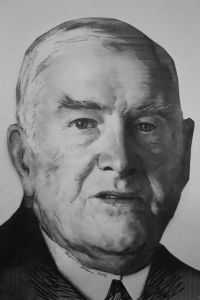
“ My daily prayer is for the sore afflicted in those quarters. Some time I have thought that it had been impossible so to have removed my affection from Scotland that any realm or nation could have been equally dear unto me; but I take God to record in my conscience that the troubles present and appearing to be in the realm of England are doubly more dolorous unto my heart than ever were the troubles of Scotland. ”
William M. Taylor
Biographical details
William M. Taylor (1876-1959) published works such as John Knox. These writings evoke Knox, Scotland and congregation.
Quotes by William M. Taylor
“ The visit of Knox to Scotland, at this juncture, was of immense service to the cause of the Reformation. The clergy, unable or unwilling to discern the signs of the times, had sunk into supineness, under the belief that what they called heresy had been well-nigh banished from the land. Arran, now Duke of Chatellerault, had given place as Regent to Mary, the mother of Mary Queen of Scots, whose policy it was just then to temporize with the Protestant nobles, and to disguise for a season her deep-rooted and undying hatred of their cause. ”
“ This year passed with little to make it memorable save a long discussion between Knox and Secretary Maitland, which originated in an attempt to restrain the freedom of the Reformer's utterances on public questions in the pulpit, and wandered over a great variety of topics, touching, among others, the duties of magistrates and their subjects, but led to no immediate practical result. The calm, however, was not of long continuance, for we come now to those troublous times and dark doings which have made the reign of Mary Queen of Scots the great debating ground of modern history. ”
“ But even in this matter, advanced as he was, Knox was not entirely above the narrowness of his age. In common with all the Reformers, and the most of the Puritans, he held that the theocracy of the Jews was the ideal state, and as a consequence, that it was the duty of the civil government to punish idolatry with death, to set up and maintain the true religion by all the means at its disposal, and to put down heresy as rebellion. ”
“ CHAPTER VII. THE TROUBLES AT FRANKFORT, 1554-1555. From Dieppe, after having launched across the channel the thunderbolt of the "Faithful Admonition," Knox retired to Geneva, where he enjoyed the friendship of John Calvin and other Swiss divines, and where, though he was now bordering on fifty years of age, he applied himself to the study of Hebrew with all the ardour of youth. But such a man could not long be permitted to enjoy learned leisure. ”
“ But caution never was one of Knox's distinctive excellences. If it had, he would not have become a Reformer, for your merely cautious men are of very little service either to their generation or to the world. Boldness is necessary for progress, and where the boldness is, we must reconcile ourselves as best we may to its attendant shadow. In the present instance Knox paid dearly enough for his imprudence, as we shall shortly see, and we may therefore content ourselves with this simple reference to it. ”
“ Knox and Murray loved and trusted each other thoroughly—perhaps all the more from the additional insight into each other's hearts {185} which their temporary estrangement gave them, and when the Regent was stricken down the Reformer felt as if his chief human helper had been taken from him. Murray was a genuine patriot, and in the main a sincere and noble man. He had his faults, and on exceptional occasions like that described by Froude, [1] when he was made the tool of Elizabeth, he was constrained to be, at least by his silence, a party to deceit which in his heart he abhorred ”
“ Thus Knox parted from the realm of England. Had he remained much longer in it, he would most probably have shared the fate of Cranmer, Ridley, Latimer, and the "noble army," whom Mary's intolerance "chased up to heaven." But God had other work for him to do, and it was well for Scotland that he listened to the entreaty of those who counselled him when he was "persecuted in one country" to "flee to another"; so it came about that for a brief season he found refuge in that land wherein only a few years before he had been a galley-slave. ”
“ As a Reformer he had in him the boldness of Luther, combined with some of the qualities of Calvin, and though as a whole he was inferior to both, yet more than either he reminds us of a Hebrew prophet. When we see him before Queen Mary, we think at once of Elijah before Ahab, and more appropriately perhaps than any other man in modern history he might have taken for the motto of his life the oft-repeated asseveration of the Tishbite, "As the Lord God of Israel liveth, before whom I stand." ”
“ The Queen Regent and her Frenchmen had marched in triumphant humour out of Falkland, with their artillery ahead, soon after midnight, trusting to find at St. Andrews {125} the two chief lords of the congregation, the Earl of Argyle and Lord James Stuart (afterwards Regent Murray) , with scarcely a hundred men about them,—found suddenly that the hundred men, by good industry over-night, had risen to an army; and that the congregation itself, under these two lords, was here, as if by tryst, at mid-distance, skilfully posted, and ready for battle either in the way of cannon or of spear. ”
“ To the elders of his Church who {198} came in a body to his room at his request, he said, "I profess before God and His holy angels that I never made merchandise of the sacred word of God; never studied to please men; never indulged my own private passions or those of others, but faithfully distributed the talents entrusted to me for the edification of the Church over which I watched. Whatever obloquy wicked men may cast upon me respecting this point, I rejoice in the testimony of a good conscience." ”
“ Among the nobles, men like Glencairn and Errol and Ruthven ranged themselves on the side of the Reformers; while the influence of a satirist like Sir David Lindsay of the Mount, and a scholar like Henry Balnaves of Halhill, was given heartily to their cause. But next only to the diffusion of the Scriptures among the people, the greatest factor in the production of the Reformation in Scotland was the degraded condition into which in that country the Church of Rome itself had sunk. "That which decayeth is ready to vanish away." ”
“ He hath taken from thee the crown of thy glory, and hath left thee without honour as a body without a head. And this appeareth to be only the beginning of sorrows, which appeareth to increase. For I perceive that the heart, the tongue, and the hand of one Englishman is bent against another, and division to be in the whole realm, which is an assured sign of desolation to come. O England! England! dost thou not consider that thy commonwealth is like a ship sailing on the sea; if thy mariners and governors shall one consume another, shalt thou not suffer shipwreck in short process of time? ”
“ Thus it is, as the body-guard of Wishart, that we get our first glimpse of John Knox in history; and very characteristic of the man this first appearance was. He comes upon the scene as unheralded as Elijah, and, like him too, he is seen from the first to be set for the defence of the truth. He was a sword-bearer all through; only when he laid aside the two-handed brand which he carried before Wishart, he took in its stead "the sword of the Spirit, which is the word of God." ”
“ Transitory life is not so sweet to me that for defence thereof I will jeopard to lose the life everlasting. Nor yet is corporeal death to me so fearful that albeit most certainly I understood the same shortly to follow my godly purpose, I would therefore depone myself to die in God's wrath and anger for ever and ever, which no doubt I should do, if for man's pleasure I refused God's perfect ordinance. ”
“ The Queen now felt that a defeat was imminent, and as a last resort, she tried to work on the sympathy of her lords by referring once more, but this time in another fashion, to the fact that Knox had made her weep. That, however, only gave him an opportunity of rehearsing all that had occurred on the occasion to which she had referred, and thereby made his victory the more sure. But what is to be said of her conduct throughout on this trial? "Heard you ever, my lords, a more despiteful and treasonable letter?" "You shall not escape so." "Is it not treason to accuse a prince of cruelty?" ”
“ In his sermon on the following Sunday Knox protested against this interference with the course of justice, using language which seems to us both temperate and kindly: "Had it been done," he said, "by the authority of a bloodthirsty man, or one who had no fear of God, he would not have been so much {188} moved; but he was affected to think that one, of whom all good men had formed so great expectations, should have fallen so low as to act such a part, one too who, when formerly in prison, had refused to purchase his own liberty by the shedding of blood." ”
“ He laid the foundation of that national popular education which has made Scotland at home so intelligent, and carried Scotsmen with honour abroad into all the countries under heaven; and though he would have protested very vehemently against the scepticism of Hume and others, yet the men who have made the Scottish school of philosophy illustrious, received, consciously or unconsciously, much of their impulse from his work. Add to this, that wherever Presbyterianism has found a foothold, its votaries name Knox side by side with Calvin, as one of its foremost leaders and organizers. ”
“ From the first he had augured nothing but evil from the accession of Mary, and it is to his honour that with such misgivings in his heart, he was at this very time in the habit of using in the pulpit a prayer of singular beauty and comprehensiveness, in which we find this petition: "Illuminate the heart of our Sovereign Lady Queen Mary with pregnant gifts of the Holy Ghost, and influence the hearts of her council with Thy true fear and love." ”
“ I trust in God I shall be the last to suffer death in Scotland in this cause." This horrible deed—done on the 28th August, 1558—thrilled the people into earnestness in a moment, and determined them to make open profession of their adherence to the Reformed worship, so that their ministers were emboldened to preach and administer the sacraments in public, even without the permission of the government, for which until then they had waited. ”
“ But the work in Scotland was too great to be successfully carried out by its own people, even if they had been united among themselves, which, unhappily, they were not. The Reformers there had to contend not only with the adherents of the papacy in their own land, but also with the power and diplomacy of France, and therefore it was of the utmost consequence that assistance from England should be secured. It was, fortunately, also quite important for England that France should be prevented from securing a permanent hold on Scotland ”
“ Now I appeal to the conscience of any indifferent (i.e. impartial) man in what one point differ the manners, estate and regiment (i.e. government) of England this day from the abuse and estate rehearsed of Judah in these days, except that they had a king, a man of his own nature (as appeared) , more facile than cruel, who sometimes was entreated in the prophet's favour, and also in some cases heard his counsel; and ye have a queen, a woman of a stout stomach (i.e. of a haughty spirit) , more stiff in opinion than flexible to the truth, who no wise may abide the presence of God's prophets. ”
“ Some disputes have arisen among the bishops, within these few days, in consequence of a sermon by a pious preacher, chaplain to the Duke of Northumberland, preached by him, before the king and Council, in which he inveighed with great freedom against kneeling at the Lord's Supper, which is still retained here in England. This good man, however, a Scotsman by nation, has so wrought upon the minds of many that we may hope some good to the church will at length arise from it, which I earnestly implore the Lord to grant. ”
“ Andrews, he had been truly charged with holding the following opinions—viz. first, man may neither make nor devise a religion that is acceptable to God, but is bound to observe and keep the religion that from God is received without chopping or changing thereof; second, the sacraments of the New Testament ought to be ministered as they were instituted by Christ Jesus and practised by the apostles, nothing ought to be added to them, nothing ought to be diminished from them; third, the mass is abominable idolatry, blasphemous to the death of Christ, and a profanation of the Lord's Supper. ”
“ The argument of his discourse on this occasion was an amplification of the following syllogism: "all worshipping, honouring, or service, invented by the brain of man, in the religion of God, without His express commandment is idolatry: the mass is invented by the brain of man without any commandment of God; therefore, the mass is idolatry." The ground here taken was identical with that which he had defended against Arbuckle, and is distinctively different from the position which, in the very same year, was taken by Cranmer in his "Defence of the true Catholic Doctrine of the Sacrament." ”
“ The liberty, the literature, the philosophy, as well as the religion of Scotland, could not have developed into what they became without the Reformation; and without Knox, humanly speaking, the Reformation would not {208} have been at all, or at least would not have been what it actually became. He had not the lyric thrill of genius that vibrates in the songs of Robert Burns; but in his own way and to his own tune he sang, "A man's a man for a' that," two hundred years before the Ayrshire bard was born. ”
“ From England Knox went to Dieppe, where he sojourned at this time for a month, and finished his exposition of the sixth Psalm, the first instalment of which he had sent to Mrs. Bowes just before leaving the shores of Britain. This production was primarily designed for the consolation and encouragement of that lady, who, as we have already hinted, seems to have been afflicted with religious melancholy. Apparently she was one of those, of whom every pastor has had some experience, who believe that God has cast them off, and who while "fearing the Lord," yet "walk in darkness and have no light." ”
“ The order for baptism follows: the father, or in his absence the godfather, is to rehearse the articles of his faith (this mention of the godfather is interesting, and some may be surprised to learn, that at the baptisms in Geneva of Knox's two sons, who were born there, Whittingham was godfather to the one and Miles Coverdale to the other) ; the minister follows with an exposition of the Creed; after that comes a prayer; then the minister taketh water in his hand, layeth it on the child's forehead, repeating the words of the formula of baptism, and closes with an offering of thanks. ”
“ This was the beginning of that demolition of Roman Catholic edifices for which Knox has been so grievously assailed. But, without entering minutely into the merits of the question, and cheerfully admitting that—owing to human imperfection—a work like that in which our Reformer was engaged could not be carried through without the doing of some things of which men in less troublous times must disapprove, we must be permitted to advance the following considerations. First, the outbreak at Perth was in a manner accidental, and was not either premeditated or instigated by Knox. ”