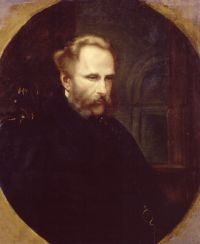
Alexander William Kinglake

Alexander William Kinglake

Summary

Portrait of Alexander William Kinglake Alexander William Kinglake,  Eothen — Chapter II. (1854)

“ If you are wise, you will not look upon the long period of time thus occupied in actual movement as the mere gulf dividing you from the end of your journey, but rather as one of those rare and plastic seasons of your life from which, perhaps, in after times you may love to date the moulding of your character—that is, your very identity. Once feel this, and you will soon grow happy and contented in your saddle-home. As for me and my comrade, however, in this part of our journey we often forgot Stamboul, forgot all the Ottoman Empire, and only remembered old times. ”
Source: Wikisource

Portrait of Alexander William Kinglake Alexander William Kinglake,  Eothen — Chapter II. (1854)

“ At first our way was in darkness, but after a while the moon got up, and touched the glittering arms and tawny faces of our men with light so pale and mystic, that the watchful Tatar felt bound to look out for demons, and take proper means for keeping them off: forthwith he determined that the duty of frightening away our ghostly enemies (like every other troublesome work) should fall upon the poor Suridgees, who accordingly lifted up their voices, and burst upon the dreadful stillness of the forest with shrieks and dismal howls. ”
Source: Wikisource

Portrait of Alexander William Kinglake Alexander William Kinglake,  Eothen — Chapter II. (1854)

“ It used to be said, that a good man, struggling with adversity, was a spectacle worthy of the gods:—a Tatar attempting to run would have been a sight worthy of you. But put him in his stirrups, and then is the Tatar himself again: there you see him at his ease, reposing in the tranquillity of that true home (the home of his ancestors) , which the saddle seems to afford him, and drawing from his pipe the calm pleasures of his "own fireside," or else dashing sudden over the earth, as though for a moment he were borne by the steed of a Turkman chief, with the plains of central Asia before him. ”
Source: Wikisource

Get perspective with Kwize: daily news enlightened by great literature