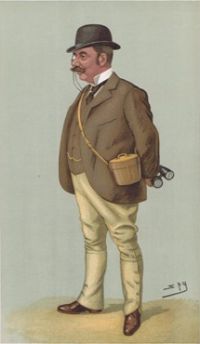
Alfred Edward Thomas Watson

Alfred Edward Thomas Watson

Summary

Portrait of Alfred Edward Thomas Watson Alfred Edward Thomas Watson 1911 Encyclopædia Britannica, Volume 13… (1911)

A kennel huntsman proper may be described as the man who does duty when the master hunts his own hounds, undertaking all the responsibilities of the huntsman except actually hunting the pack. It may be said that the first duty of a huntsman is to obtain the confidence of his hounds, to understand them and to make himself understood; and the intelligence of hounds is remarkable. If, for example, it is the habit of the huntsman to give a single note on his horn when hounds are drawing a covert, and a double note when a fox is found, the pack speedily understand the significance.
Source: Wikisource

Portrait of Alfred Edward Thomas Watson Alfred Edward Thomas Watson 1911 Encyclopædia Britannica, Volume 13… (1911)

There are many ways in which a whipper-in who is not intelligent and alert may spoil sport; indeed, the duke of Beaufort went so far as to declare that “in his experience, with very few exceptions, nine days out of ten that the whipper-in goes out hunting he does more harm than good.” In woodland countries, however, a good whipper-in is really of almost as much importance as the huntsman himself; if he is not alert the hounds are likely to divide, as when running a little wide they are apt to put up a fresh fox.
Source: Wikisource

Portrait of Alfred Edward Thomas Watson Alfred Edward Thomas Watson 1911 Encyclopædia Britannica, Volume 13… (1911)

Capital exercise and much useful knowledge are to be derived by running with a pack of beagles. There are the same difficulties to be contended with as in hunting with the ordinary harrier, and a very few days’ running will teach the youthful sportsman that he cannot run at the same pace over sound ground and over a deep ploughed field, up hill and down, or along and across furrows.
Source: Wikisource

Get perspective with Kwize: daily news enlightened by great literature