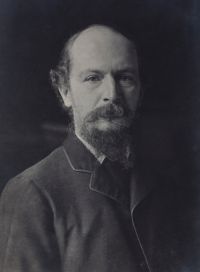
Algernon Charles Swinburne

Algernon Charles Swinburne

Summary

Portrait of Algernon Charles Swinburne Algernon Charles Swinburne Songs of Two Nations — A Song of Italy (1875)

O thou her flower of flowers, with treble braid
Be thy sweet head arrayed,
In witness of her mighty motherhood
Who bore thee and found thee good,
Her fairest-born of children, on whose head
Her green and white and red
Are hope and light and life, inviolate
Of any latter fate.
Fly, O our flag, through deep Italian air,
Above the flags that were,
The dusty shreds of shameful battle-flags
Trampled and rent in rags,
As withering woods in autumn's bitterest breath
Yellow, and black as death;
Black as crushed worms that sicken in the sense,
And yellow as pestilence.
Source: Wikisource

Portrait of Algernon Charles Swinburne Algernon Charles Swinburne Songs of Two Nations — A Song of Italy (1875)

Their lowest head that lies.
Speak from thy lips of immemorial speech
If but one word for each.
Kiss but one kiss on each thy dead son's mouth
Fallen dumb or north or south.
And laying but once thine hand on brow and breast,
Bless them, through whom thou art blest.
And saying in ears of these thy dead, 'Well done,'
Shall they not hear 'O son'?
And bowing thy face to theirs made pale for thee,
Shall the shut eyes not see?
Yea, through the hollow-hearted world of death,
As light, as blood, as breath,
Shall there not flash and flow the fiery sense,
The pulse of prescience?
Source: Wikisource

Portrait of Algernon Charles Swinburne Algernon Charles Swinburne Songs of Two Nations — A Song of Italy (1875)

Thee loftiest to the last?
For times and wars shall change, kingdoms and creeds,
And dreams of men, and deeds;
Earth shall grow grey with all her golden things,
Pale peoples and hoar kings;
But though her thrones and towers of nations fall,
Death has no part in all;
In the air, nor in the imperishable sea,
Nor heaven, nor truth, nor thee.
Yea, let all sceptre-stricken nations lie,
But live thou though they die;
Let their flags fade as flowers that storm can mar,
But thine be like a star
Source: Wikisource

Get perspective with Kwize: daily news enlightened by great literature