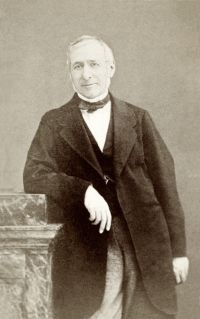
Alphonse de Candolle

Alphonse de Candolle

Summary

Portrait of Alphonse de Candolle Alphonse de Candolle Origin of Cultivated Plants

It has been commonly asserted, even in our own day, that a species cultivated in America or China is a native of America or China. A no less common error is the belief that a species comes originally from a given country because it has come to us from thence, and not direct from the place in which it is really indigenous. Thus the Greeks and Romans called the peach the Persian apple, because they had seen it cultivated in Persia, where it probably did not grow wild.
Source: Gutenberg

Portrait of Alphonse de Candolle Alphonse de Candolle Origin of Cultivated Plants

This diversity is on two heads; first as to the descent of a given cultivated variety, and secondly as to the distinction of the wild forms into species or varieties.
I do not pretend to classify the innumerable cultivated forms, and I think that labour useless when dealing with the question of geographical origin, for the differences lie principally in the shape, size, colour, and taste of the fruit, in characters, that is to say, which it has been the interest of horticulturists to cultivate when they occur, and even to create as far as it was in their power to do so.
Source: Gutenberg

Portrait of Alphonse de Candolle Alphonse de Candolle Origin of Cultivated Plants

I am aware that Sir Joseph Hooker [1] has enumerated more than a hundred Australian species which may be used in some way; but as a matter of fact they were not cultivated by the natives, and, in spite of the improved methods of the English colonists, no one does cultivate them. This clearly demonstrates the principle of which I spoke just now, that the choice of species is more important than the selection of varieties, and that there must be valuable qualities in a wild plant in order to lead to its cultivation.
Source: Gutenberg

Get perspective with Kwize: daily news enlightened by great literature