Summary

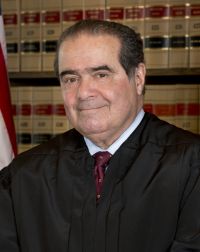
Portrait of Antonin Scalia Antonin Scalia Wisconsin Public Intervenor v. Mortier…

If I believed, however, that the meaning of a statute is to be determined by committee reports, I would have to conclude that a meaning opposite to our judgment has been commanded three times over-not only by one committee in each house, but by two committees in one of them. Today's decision reveals that, in their judicial application, committee reports are a forensic rather than an interpretive device, to be invoked when they support the decision and ignored when they do not. To my mind that is infinitely better than honestly giving them dispositive effect.
Source: Wikisource

Portrait of Antonin Scalia Antonin Scalia Wisconsin Public Intervenor v. Mortier…

I confess that I am less practiced than others in the science of construing legislative history, but it seems to me that quite the opposite is the case. The Senate Commerce Committee Report does not offer a different interpretation of the pre-emptive effect of H.R. 10729. To the contrary, it acknowledges that the report of the originating committee "states explicitly that local governments cannot regulate pesticides in any manner," and then proceeds to a statement ("Many local governments now regulate pesticides, etc.")
Source: Wikisource

Portrait of Antonin Scalia Antonin Scalia Wisconsin Public Intervenor v. Mortier…

As the Court today recognizes, see ante, at 606-607, the Wisconsin Justices agreed with me on this point, and would have come out the way that I and the Court do but for the Committee Reports contained in FIFRA's legislative history. I think they were entirely right about the tenor of those reports. Their only mistake was failing to recognize how unreliable Committee Reports are-not only as a genuine indicator of congressional intent but as a safe predictor of judicial construction. We use them when it is convenient, and ignore them when it is not.
Source: Wikisource

Get perspective with Kwize: daily news enlightened by great literature