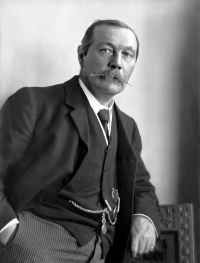
Arthur Conan Doyle

Arthur Conan Doyle

Summary

Portrait of Arthur Conan Doyle Arthur Conan Doyle The Doings of Raffles Haw — Chapter X (1892)

If bismuth turned into mercury, what would mercury turn into? There would be no rest for me until I had solved the question. I renewed the exhausted batteries and passed the current through the bowl of quicksilver. For sixteen hours I sat watching the metal, marking how it slowly seemed to curdle, to grow firmer, to lose its silvery glitter and to take a dull yellow hue. When I at last picked it up in a forceps, and threw it upon the table, it had lost every characteristic of mercury, and had obviously become another metal.
Source: Wikisource

Portrait of Arthur Conan Doyle Arthur Conan Doyle The Doings of Raffles Haw — Chapter X (1892)

You say, Robert, that you have some slight knowledge of chemistry, and you will find it easier to follow what I say. Chemistry is to a large extent an empirical science, and the chance experiment may lead to greater results than could, with our present data, be derived from the closest study or the keenest reasoning. The most important chemical discoveries from the first manufacture of glass to the whitening and refining of sugar have all been due to some happy chance which might have befallen a mere dabbler as easily as a deep student.
Source: Wikisource

Portrait of Arthur Conan Doyle Arthur Conan Doyle The Doings of Raffles Haw — Chapter X (1892)

I had frequently speculated as to the effect which powerful currents of electricity exercise upon any substance through which they are poured for a considerable time. I did not here mean such feeble currents as are passed along a telegraph wire, but I mean the very highest possible developments. Well, I tried a series of experiments upon this point. I found that in liquids, and in compounds, the force had a disintegrating effect. The well-known experiment of the electrolysis of water will, of course, occur to you.
Source: Wikisource

Get perspective with Kwize: daily news enlightened by great literature