Summary

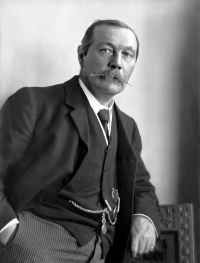
Portrait of Arthur Conan Doyle Arthur Conan Doyle The Great Boer War — Chapter 6 Elandslaagte and Rietfontein (1900)

On the whole, this brilliant little action may be said to have restored things to their true proportion, and to have shown that, brave as the Boers undoubtedly are, there is no military feat within their power which is not equally possible to the British soldier. Talana Hill and Elandslaagte, fought on successive days, were each of them as gallant an exploit as Majuba.
We had more to show for our victory than for the previous one at Dundee. Two Maxim-Nordenfeld guns, whose efficiency had been painfully evident during the action, were a welcome addition to our artillery.
Source: Wikisource

Portrait of Arthur Conan Doyle Arthur Conan Doyle The Great Boer War — Chapter 6 Elandslaagte and Rietfontein (1900)

Men fell fast, but their comrades pressed hotly on. There was a long way to go, for the summit of the position was nearly 800 feet above the level of the railway. The hillside, which had appeared to be one slope, was really a succession of undulations, so that the advancing infantry alternately dipped into shelter and emerged into a hail of bullets. The line of advance was dotted with khaki-clad figures, some still in death, some writhing in their agony.
Source: Wikisource

Portrait of Arthur Conan Doyle Arthur Conan Doyle The Great Boer War — Chapter 6 Elandslaagte and Rietfontein (1900)

He had one battery of the Natal artillery, with their little seven-pounder popguns, five squadrons of the Imperial Horse, and, in the train which slowly accompanied his advance, half a battalion of the Manchester Regiment. Elated by the news of Talana Hill, and anxious to emulate their brothers of Dundee, the little force moved out of Ladysmith in the early morning.
Some at least of the men were animated by feelings such as seldom find a place in the breast of the British soldier as he marches into battle.
Source: Wikisource

Get perspective with Kwize: daily news enlightened by great literature