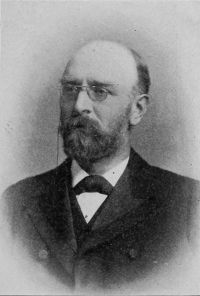
Arthur Smith Woodward

Arthur Smith Woodward

Summary

Portrait of Arthur Smith Woodward Arthur Smith Woodward 1911 Encyclopædia Britannica, Volume 20… (1911)

Another family, known only by nearly complete skeletons from the Upper Silurian mud stones of Lanarkshire, is that of the Birkeniidae, comprising small fusiform species which are covered with granules disposed in curiously-arranged rows. The highest Ostracoderms are the Asterolepidae, which occur only in Devonian rocks and include the familiar Pterichthys (fig. 4) from the Middle Old Red Sandstone of Scotland. In this family the primitive skin-tubercles seem to have fused, not into polygonal plates, but along the lines of the slime-canals.
Source: Wikisource

Portrait of Arthur Smith Woodward Arthur Smith Woodward 1911 Encyclopædia Britannica, Volume 20… (1911)

The eyes are far forwards and wide apart. In another family, that of the Cephalaspidae (fig. 2) , the animals resemble the Coelolepids in shape, but their skin granules are fused into small plates, which are polygonal where there must have been much flexibility, and in rings round the tail where the underlying successive plates of muscle necessitated this arrangement. The eyes are close together. At the opening of the gill-cavity on each side at the back of the head, there is a flexible flap, which is sometimes interpreted as a paired limb.
Source: Wikisource

Get perspective with Kwize: daily news enlightened by great literature