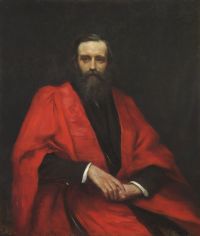
 Arthur Woollgar Verrall,
Encyclopædia Britannica, Ninth Edition
(1888)
Arthur Woollgar Verrall,
Encyclopædia Britannica, Ninth Edition
(1888)
“ The most famous monument of ancient Thebes was the outer wall with its seven gates, which even as late as the 6th century B.O. was probably the largest of artificial Greek fortresses. The names of the gates vary, but four are constant, the Free tides, Electrse, Neistae or Neitse, and Homoloides; Pausanias gives the others as Ogygise, Hypsistse, Crenaese. There is evidence that the gate Electee was on the south, and near it was the tomb of the Thebans who fell at the capture by Alexander. The gates shown to Pausanias as Neistse and Prcetides led respectively north-west and north-east. ”
