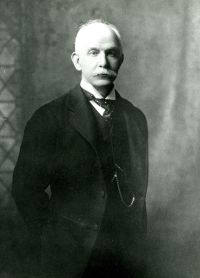
Brooks Adams

Brooks Adams

Summary

Portrait of Brooks Adams Brooks Adams The Law of Civilization and Decay… (1896 | notes)

Thus, by the middle of the twelfth century, the idealist had begun to flag in the struggle for life.
An attempt, indeed, was afterwards made upon Damascus, but it only served to expose the weakness of the men who relied on magic. By the time the advance began, confidence had been restored among the Saracens, the attack was repulsed, and Nour-ed-Din had only to move from the north to throw the crusaders back upon Jerusalem, covered with ridicule. Nothing conveys so vivid an idea of the shock these reverses gave believers, as the words in which Saint Bernard defended his prophecies.
Source: Wikisource

Portrait of Brooks Adams Brooks Adams The Law of Civilization and Decay… (1896 | notes)

Perhaps no one ever lived more highly gifted with the ecstatic temperament than Saint Bernard. He had the mysterious attribute of miracles, and, in the twelfth century, the miracle was, perhaps, the highest expression of force. To work them was a personal gift, and the possessor of the faculty might, at his caprice, use his power, like the sorcerer, to aid or injure other men.
Source: Wikisource

Portrait of Brooks Adams Brooks Adams The Law of Civilization and Decay… (1896 | notes)

After explaining that he had been chosen commander against his will, he exclaimed, "Who am I, that I should set camps in order, or should march before armed men? Or what is so remote from my profession, even had I the strength, and the knowledge were not lacking? . . . I beseech you, by that charity you especially owe me, that you do not abandon me to the wills of men."
Source: Wikisource

Get perspective with Kwize: daily news enlightened by great literature