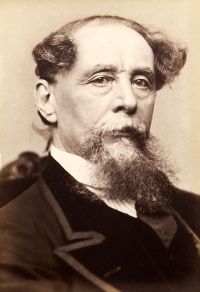
Charles Dickens

Charles Dickens

Summary

Portrait of Charles Dickens Charles Dickens,  Barnaby Rudge — Chapter 33 (1841)

“ No man stirred.
It was in this emergency that Mr Willet displayed something of that strength of mind and plenitude of mental resource, which rendered him the admiration of all his friends and neighbours. After looking at Messrs Parkes and Cobb for some time in silence, he clapped his two hands to his cheeks, and sent forth a roar which made the glasses dance and rafters ring—a long-sustained, discordant bellow, that rolled onward with the wind, and startling every echo, made the night a hundred times more boisterous—a deep, loud, dismal bray, that sounded like a human gong.
”
Source: Wikisource

Portrait of Charles Dickens Charles Dickens,  Barnaby Rudge — Chapter 33 (1841)

“ In private dwellings, children clustered near the blaze; listening with timid pleasure to tales of ghosts and goblins, and tall figures clad in white standing by bed-sides, and people who had gone to sleep in old churches and being overlooked had found themselves alone there at the dead hour of the night: until they shuddered at the thought of the dark rooms upstairs, yet loved to hear the wind moan too, and hoped it would continue bravely. ”
Source: Wikisource

Portrait of Charles Dickens Charles Dickens,  Barnaby Rudge — Chapter 33 (1841)

“ I have heard it said that as we keep our birthdays when we are alive, so the ghosts of dead people, who are not easy in their graves, keep the day they died upon.—How the wind roars!’
Nobody spoke. All eyes were fastened on Solomon.
‘I might have known,’ he said, ‘what night it was, by the foul weather. There’s no such night in the whole year round as this is, always. I never sleep quietly in my bed on the nineteenth of March.’
‘Go on,’ said Tom Cobb, in a low voice. ‘Nor I neither.’
Solomon Daisy raised his glass to his lips
”
Source: Wikisource

Get perspective with Kwize: daily news enlightened by great literature