Summary

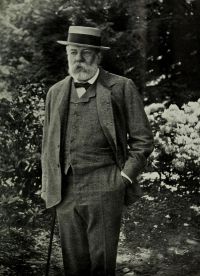
Portrait of Charles Sprague Sargent Charles Sprague Sargent Manual of the Trees of North America…

A tree, with aromatic bark and leaves, 70°—80° high, with a trunk 2°—5° in diameter, slender branches spreading almost at right angles, becoming pendulous toward the ends and gradually forming a narrow round-topped open graceful head, and branchlets light green, slightly viscid and pilose when they first appear, soon turning dark orange-brown, lustrous during the summer, bright red-brown in their first winter, becoming darker and finally dark dull brown slightly tinged with red.
Source: Gutenberg

Portrait of Charles Sprague Sargent Charles Sprague Sargent Manual of the Trees of North America…

The indigenous trees of no other region of equal extent are, perhaps, so well known as those that grow naturally in North America. There is, however, still much to be learned about them. In the southern states, one of the most remarkable extratropical regions in the world in the richness of its arborescent flora, several species are still imperfectly known, while it is not improbable that a few may have escaped entirely the notice of botanists
Source: Gutenberg

Portrait of Charles Sprague Sargent Charles Sprague Sargent Manual of the Trees of North America…

Fruit ripening during the spring and early summer, subglobose, 1⁄3′ in diameter, tipped with the conspicuous blackened remnants of the stigmas, bright red, covered with soft pubescence, solitary or in clusters of 2 or 3, deciduous at maturity from its stout stalk enlarged at apex and 1⁄4′ long; flesh thin and crustaceous, closely investing the thin-walled crustaceous stone; seed usually solitary by abortion, obovoid, gibbous, 1⁄8′ long, narrowed below, narrowed and marked at apex by the elevated pale hilum and on the inner surface of the seed-coat by the broad conspicuous raphe.
Source: Gutenberg

Get perspective with Kwize: daily news enlightened by great literature