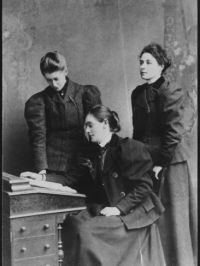
Edith Palliser

Edith Palliser

Summary

Portrait of Edith Palliser Edith Palliser The Case for Women's Suffrage… (1907)

In considering the many predisposing causes which led very gradually up to the demand by women for their political enfranchisement, it is interesting to note that it was from a passionate desire for a reform of the unsatisfactory and in many cases degrading social and political conditions of their country, together with a chivalrous pity for the weak and friendless, that women first learnt to realise the special need of the franchise for themselves.
Source: Wikisource

Portrait of Edith Palliser Edith Palliser The Case for Women's Suffrage… (1907)

This is true not only of American and English women but of women in all countries. We have had recent examples in the women of Russia and Finland who have thrown themselves wholeheartedly into the work for political freedom, sharing with men in all the dangers and suffering equally with them in the attempt to obtain liberty for their country. The Women's Suffrage Movement was not, as has been asserted, the outcome of an agitation by a few women of ill-balanced minds, inspired by an unreasonable hatred of men.
Source: Wikisource

Portrait of Edith Palliser Edith Palliser The Case for Women's Suffrage… (1907)

The policy to be pursued in every country must of necessity vary with its political conditions, but the arguments against Women's Suffrage that have to be combated and the prejudices encountered are precisely the same. Those countries which already possess the franchise can furnish facts to prove that the prophecies of evil results following on the enfranchisement of women have been falsified.
Source: Wikisource

Get perspective with Kwize: daily news enlightened by great literature