Summary

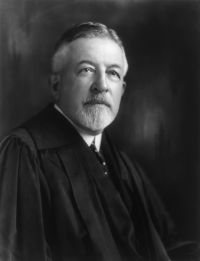
Portrait of Edward Terry Sanford Edward Terry Sanford Federal Trade Commission v. Eastman Kodak Company…

Case, the Clayton Act prohibits only the acquisition of stock and not the assets of the competing corporation, and in terms merely authorizes an order requiring the corporation 'to cease and desist from such violations, and divest itself of the stock held. * * *' For that reason alone, the majority of the court thought that the language of these provisions was not broad enough to enable the Commission to order the corporation to divest itself of the physical assets thus acquired although their acquisition aggravated and brought to its final consummation the very evil aimed at by the statute.
Source: Wikisource

Portrait of Edward Terry Sanford Edward Terry Sanford Federal Trade Commission v. Eastman Kodak Company…

We may lay aside the question whether one already possessing monopoly powers in one field, especially where as here there is no available substitute for his products may make use of his strategic position to dominate all phases of the industry from production to consumption. For here it seems fairly inferable from the stipulated facts that there was no intention of permanent expansion. The Eastman Company threatened to engage in temporary competition with the manufacturers of prints in order to attain its objective-the suppression of foreign competition in raw film.
Source: Wikisource

Portrait of Edward Terry Sanford Edward Terry Sanford Federal Trade Commission v. Eastman Kodak Company…

The advised use of the phrase 'unfair methods of competition' for the more familiar 'unfair competition' of the common law indicates an unmistakable congressional intent to confer on the Commission the power, subject of course to the judicial review provided for in the Act, to prevent unfair trade practices not included in the prohibition of the Sherman Act and of the common law.
Source: Wikisource

Get perspective with Kwize: daily news enlightened by great literature