Summary

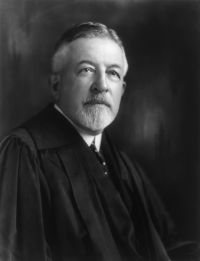
Portrait of Edward Terry Sanford Edward Terry Sanford Liberty Warehouse Company v. Grannis…

That judicial power, as we have seen, is the right to determine actual controversies arising between adverse litigants, duly instituted in courts of proper jurisdiction. * * * This attempt to obtain a judicial declaration of the validity of the act of Congress is not presented in a 'case' or 'controversy,' to which under the Constitution of the United States, the judicial power alone extends.
Source: Wikisource

Portrait of Edward Terry Sanford Edward Terry Sanford Liberty Warehouse Company v. Grannis…

The sole purpose of the petition, as shown by its express allegations, is to obtain a declaration from the District Court of the rights and duties of the plaintiffs under the Act of 1924, and a determination of the extent to which they must comply with its provisions in the conduct of their business. This is its entire scope. While the Commonwealth Attorney is made a defendant as a representative of the Commonwealth, there is no semblance of any adverse litigation with him individually
Source: Wikisource

Portrait of Edward Terry Sanford Edward Terry Sanford Liberty Warehouse Company v. Grannis…

The Declaratory Judgment Law of Kentucky, Acts of 1922, ch. 83, provides that in any action in a court of record of that Commonwealth having general jurisdiction wherein it is made to appear that an actual controversy sexists, the plaintiff may, by means of a petition on the law or equity side of the court, as the nature of the case may require, ask for and obtain 'a declaration of rights, either alone or with other relief
Source: Wikisource

Get perspective with Kwize: daily news enlightened by great literature