Summary

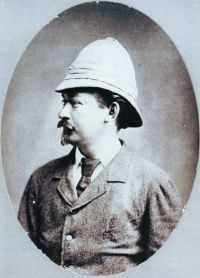
Portrait of Emil Holub Emil Holub Seven years in South Africa Volume 2… (1881)

The most experienced hunter is only too likely to lose his composure if one of the giants of the forest is found face to face with him before he has time to prepare his weapon. No more unfortunate plight can be imagined, than that of a naturalist or a botanist engrossed in his studies, and suddenly disturbed by the growl of a lion close beside him. Natives seated round their fire may perhaps hope to escape, but for the solitary individual in the depths of the wood, there can be no reprieve.
Source: Gutenberg

Portrait of Emil Holub Emil Holub Seven years in South Africa Volume 2… (1881)

Westbeech and Francis took possession of the ivory, leaving the carcase to the servants who had smelt it out. They cut off the feet, intending to carry them off as a dainty for their next meal, but the stench of them was so intolerable that we soon made them throw their tit-bit away. When cooked fresh the fleshy substance enclosed beneath the tough skin of the elephant’s foot is accounted as choice a morsel as a bear’s paw, but it is the only fragment of the brute that is in any way suited for human food.
Source: Gutenberg

Portrait of Emil Holub Emil Holub Seven years in South Africa Volume 2… (1881)

Unless one crocodile is assisted by another, it cannot by itself tear a fresh corpse in pieces; but it has to wait until the process of decomposition sets in, when the gaseous exhalations raise it to the surface in a condition that permits it to be torn asunder and devoured piecemeal. If a crocodile’s attention should be attracted by a fish, or anything else that seems fit for food, it will forsake its larger prey in the day-time, but only to return to it in the evening.
Source: Gutenberg

Get perspective with Kwize: daily news enlightened by great literature