Summary

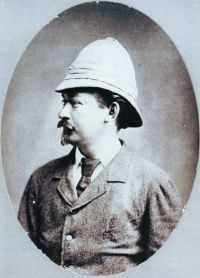
Portrait of Emil Holub Emil Holub Seven years in South Africa volume 1… (1881)

A landscape of peculiar beauty lay outstretched around us. The Hebron heights and their dark spurs veiled in purple haze bounded the horizon to the south and west, whilst to the north and east the vast plains were shrouded in the distance by a deepening tint, a sure token that the night would be one of those that in South Africa are ever to be remembered for their splendour. A soft air was swaying the flowery grass, of which the seeds had been sown by the wind and imbedded in the soil by the feet of the game.
Source: Gutenberg

Portrait of Emil Holub Emil Holub Seven years in South Africa volume 1… (1881)

Wearing only a small piece of hide round his loins, and carrying nothing more than a little shield of eland-hide, the Masarwa suffers a good deal from cold; but instead of putting his fireplace within an enclosure, like the Bechuana, or inside his hut, like the Koranna, he lights his fire in the open air, and squats down so close to it in order to feel its glow, that as he sleeps with his head on his knees, he is always getting frightfully scorched, and his skin becomes burnt to the colour of an ostrich’s legs.
Source: Gutenberg

Portrait of Emil Holub Emil Holub Seven years in South Africa volume 1… (1881)

On our way to Cradock I had my first sight of those vast plains that stretch as far as the eye can reach, and which during the rainy season present an illimitable surface of dark green or light, according as they are covered with bush or grass, but which, throughout all the dry period of the year, are merely an expanse of dull red desert. They abound in the west of Cape Colony, in the Free State, in the Transvaal, and in the Batlapin countries, and are the habitations of the lesser bustard, the springbock, the blessbock, and the black gnu.
Source: Gutenberg

Get perspective with Kwize: daily news enlightened by great literature