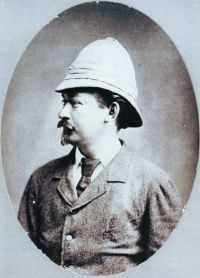
Emil Holub

Emil Holub

Summary

Portrait of Emil Holub Emil Holub Seven Years in South Africa (1881)

I threw my gun upon the ground and managed to alight, and finally to drag the excited animal clear away; but my face, my arms, my neck, even my legs, were all smarting violently; and when I made my way back to the waggon, I was only to be compared to the triumphant hero of a cat-fight. I am not likely to forget my experience of that mimosa-tree. Nature, like a cruel step-mother, seems to have banished some of the offspring of Flora, unendowed with fragrancy or honey, to the desert wilds of Africa, where they take their revenge on any unoffending mortals that come within their reach.
Source: Wikisource

Portrait of Emil Holub Emil Holub Seven Years in South Africa (1881)

On looking out of the waggon I saw Meriko, my Bamangwato servant, running with all his might through the long grass, and shrieking, in the Sechuana dialect, “They are killing me! they are killing me!” He cleared the bushes like an antelope; in his hurry he had lost both his grass hat and his caama mantle, and had scarcely breath to reach the waggon. Pointing to a number of natives at no great distance from him, with their spears brandished in the air, he gasped out, “Zulus! Matabele! they want to kill me!”
Source: Wikisource

Portrait of Emil Holub Emil Holub Seven Years in South Africa (1881)

A landscape of peculiar beauty lay outstretched around us. The Hebron heights and their dark spurs veiled in purple haze bounded the horizon to the south and west, whilst to the north and east the vast plains were shrouded in the distance by a deepening tint, a sure token that the night would be one of those that in South Africa are ever to be remembered for their splendour. A soft air was swaying the flowery grass, of which the seeds had been sown by the wind and imbedded in the soil by the feet of the game.
Source: Wikisource

Get perspective with Kwize: daily news enlightened by great literature