Summary

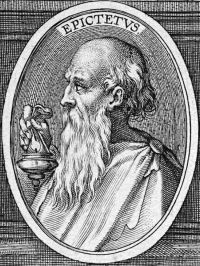
Portrait of Epictetus Epictetus Epictetus, the Discourses as reported by Arrian… (1925)

What is the work [3] of virtue? Serenity. Who, then, is making progress? The man who has read many treatises of Chrysippus? What, is virtue no more than this—to have gained a knowledge of Chrysippus? For if it is this, progress is confessedly nothing else than a knowledge of many of the works of Chrysippus. But now, while acknowledging that virtue produces one thing, we are declaring that the approach to virtue, which is progress, produces something else. "So-and-so," says someone, "is already able to read Chrysippus all by himself." It is fine headway, by the gods, that you are making, man!
Source: Wikisource

Portrait of Epictetus Epictetus Epictetus, the Discourses as reported by Arrian… (1925)

For if he avoids anything that is not a matter of free choice, he knows that some time he will encounter something in spite of his aversion to it, and will come to grief. Now if it is virtue that holds out the promise thus to create happiness and calm and serenity, then assuredly progress toward virtue is progress toward each of these states of mind. For it is always true that whatsoever the goal toward which perfection in anything definitely leads, progress is an approach thereto.
Source: Wikisource

Portrait of Epictetus Epictetus Epictetus, the Discourses as reported by Arrian… (1925)

But if he has striven merely to attain the state which he finds in his books and works only at that, and has made that the goal of his travels, I bid him go home at once and not neglect his concerns there, since the goal to which he has travelled is nothing; but not so that other goal—to study how a man may rid his life of sorrows and lamentations, and of such cries as "Woe is me!"
Source: Wikisource

Get perspective with Kwize: daily news enlightened by great literature