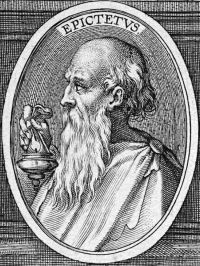
 Epictetus,
 the Discourses as reported by Arrian…
(1925)
Epictetus,
Epictetus, the Discourses as reported by Arrian…
(1925)
“ What a man ought to learn before he will know how to conduct an argument has been precisely defined by the philosophers of our school; but as to the proper use of what we have learned we are still utterly inexperienced. At all events, give to anyone of us you please some layman with whom to carry on an argument; he will find no way of dealing with him, but after moving the man a little, in case the latter thwarts him, our man gives up trying to handle him, and thereafter either reviles him, or laughs him to scorn, and remarks, "He is a mere layman; it is impossible to do anything with him." ”
