Summary

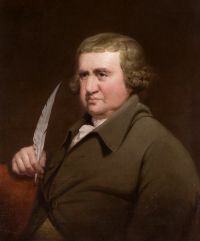
Portrait of Erasmus Darwin Erasmus Darwin Zoonomia, or, the Laws of Organic Life… (1796)

This leads us to a curious enquiry, whether vegetables have ideas of external things? As all our ideas are originally received by our senses, the question may be changed to, whether vegetables possess any organs of sense? Certain it is, that they possess a sense of heat and cold, another of moisture and dryness, and another of light and darkness; for they close their petals occasionally from the presence of cold, moisture, or darkness.
Source: Wikisource

Portrait of Erasmus Darwin Erasmus Darwin Zoonomia, or, the Laws of Organic Life… (1796)

Whence it appears that the buds of deciduous trees are so many annual plants, that the bark is a contexture of the roots of each individual bud; and that the internal wood is of no other use but to support them in the air, and that thus they resemble the animal world in their individuality.
The irritability of plants, like that of animals, appears liable to be increased or decreased by habit; for those trees or shrubs, which are brought from a colder climate to a warmer, put out their leaves and blossoms a fortnight sooner than the indigenous ones.
Source: Wikisource

Portrait of Erasmus Darwin Erasmus Darwin Zoonomia, or, the Laws of Organic Life… (1796)

This appears particularly in the mimosa or sensitive plant, whose leaves contract on the slightest injury; the dionæa muscipula, which was lately brought over from the marshes of America, presents us with another curious instance of vegetable irritability; its leaves are armed with spines on their upper edge, and are spread on the ground around the stem; when an insect creeps on any of them in its passage to the flower or seed, the leaf shuts up like a steel rat-trap, and destroys its enemy.
Source: Wikisource

Get perspective with Kwize: daily news enlightened by great literature