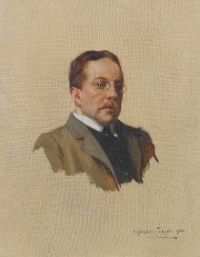
Ernest William Hornung

Ernest William Hornung

Summary

Portrait of Ernest William Hornung Ernest William Hornung A Bride from the Bush — I (1890)

If they are realised, no one will sympathise with poor dear Alfred more deeply than I shall.'
Lady Bligh looked keenly at her eloquent son; a half-smile played about her lips: she understood him, to some extent.
'But what if your fears are not realised?' she said, quietly.
'Why, then,' said Gran, less fluently, 'then I—oh, of course, I shall be delighted beyond words; no one will be more delighted than I.'
'Then you shall see,' said Lady Bligh, rising, with a sweet and hopeful smile, 'that is how it is going to turn out; I have a presentiment that it will all turn out for the best.
Source: Wikisource

Portrait of Ernest William Hornung Ernest William Hornung A Bride from the Bush — I (1890)

There was cleverness in every line of his smooth dark face; there was uncommon shrewdness in his clear gray eyes. His father had the same face and the same eyes—with this difference added to the differences naturally due to age: there were wisdom, and dignity, and humanity in the face and glance of the Judge; but the nobility of expression thus given was not inherited by the Judge's younger son.
Source: Wikisource

Portrait of Ernest William Hornung Ernest William Hornung A Bride from the Bush — I (1890)

A LETTER FROM ALFRED
There was consternation in the domestic camp of Mr Justice Bligh on the banks of the Thames. It was a Sunday morning in early summer. Three-fourths of the family sat in ominous silence before the mockery of a well-spread breakfast-table: Sir James and Lady Bligh and their second son, Granville. The eldest son—the missing complement of this family of four—was abroad. For many months back, and, in fact, down to this very minute, it had been pretty confidently believed that the young man was somewhere in the wilds of Australia
Source: Wikisource

Get perspective with Kwize: daily news enlightened by great literature