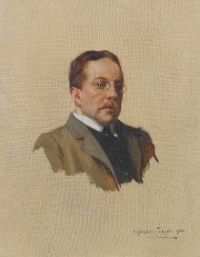
Ernest William Hornung

Ernest William Hornung

Summary

Portrait of Ernest William Hornung Ernest William Hornung A Bride from the Bush — XVIII (1890)

There could have been no better cabin for 'a life awry' (not even in the Bush, the living sepulchre of so many such) than the Yelkin hut. But it was not the place to forget in. There are, however, strong natures that can never forget, and still live on. There are still stronger natures that do not seek to forget, yet retain some of the joy of living side by side with the full sorrow of remembrance. The boundary-rider's was one of these.
Source: Wikisource

Portrait of Ernest William Hornung Ernest William Hornung A Bride from the Bush — XVIII (1890)

THE BOUNDARY-RIDER OF THE YELKIN PADDOCK
Picture the Great Sahara. The popular impression will do: it has the merit of simplicity: glaring desert, dark-blue sky, vertical sun, and there you are. Omit the mirage and the thirsty man; but, instead, mix sombre colours and work up the African desert into a fairly desirable piece of Australian sheep-country.
This, too, is a simple matter. You have only to cover the desert with pale-green saliferous bushes, no higher than a man's knee; quite a scanty covering will do, so that in the thickest places plenty of sand may still be seen
Source: Wikisource

Portrait of Ernest William Hornung Ernest William Hornung A Bride from the Bush — XVIII (1890)

The conspicuous mark upon the distant belt of dingy low-sized forest—the object that glitters in the strong sunlight, so that it can be seen across miles and miles of plain—is merely the galvanised-iron roof of a log-hut, the hut that has been the lodging of the boundary-rider of the Yelkin Paddock ever since the Yelkin Paddock was fenced.
A boundary-rider is not a 'boss' in the Bush, but he is an important personage, in his way.
Source: Wikisource

Get perspective with Kwize: daily news enlightened by great literature