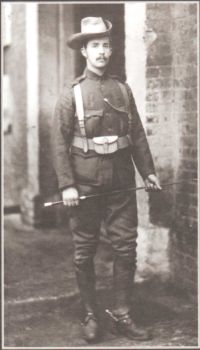
Erskine Childers

Erskine Childers

Summary

Portrait of Erskine Childers Erskine Childers War and the Arme Blanche

The firearm, which, remember, should be a better weapon, if anything, than the Infantry rifle, is given many offensive as well as defensive rôles. Pursuits, for example, must not be “frontal,” because “Cavalry can easily be held up by any rear-guard position in which a few intact troops remain.” But who, we wonder, are these “intact troops”? Why not Cavalry, or mounted riflemen, as in South Africa? Is not rear-guard work a conventional and normal function of Cavalry itself? And if it is a case of Cavalry versus Cavalry, why not shock, at the compulsion of one side or the other?
Source: Gutenberg

Portrait of Erskine Childers Erskine Childers War and the Arme Blanche

It has always been the belief of the arme blanche school that steel horsemen if they cannot charge dismounted riflemen, can at any rate charge their led horses. All the facts, as I shall show, prove this idea to be illusory.
And now, on behalf of the rifle, let us carry the war into the enemy’s camp, regarding the rifle, not as a defensive, but as an aggressive weapon in the hands of mounted men. Save for the elimination of weight, the physical merits and demerits of the horse remain precisely the same: speed on the one hand, vulnerability on the other.
Source: Gutenberg

Portrait of Erskine Childers Erskine Childers War and the Arme Blanche

Is saddle-fire an accomplishment our Cavalry cannot acquire—an accomplishment which at this very moment we inculcate for “picked men and scouts” of the Mounted Infantry, a force with not a quarter of the mounted training that the Cavalry receive? For professional troops it cannot be more difficult to acquire than skill with the steel weapon on horseback. That is an art which, as everybody knows, demands long and continuous drill and practice.
Source: Gutenberg

Get perspective with Kwize: daily news enlightened by great literature