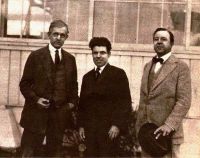
Eugene Manlove Rhodes

Eugene Manlove Rhodes

Summary

Portrait of Eugene Manlove Rhodes Eugene Manlove Rhodes The Line of Least Resistance — Chapter 2 (1910)

Now, near the head of Mescal, Hiram Yoast and Don Kennedy espied by chance a clump of tender greenery—a wild grapevine, small but thrifty. This, in the arid lands, cannot live unless the roots reach to living water. Hiram made camp with saddle blankets and both canteens, while Kennedy rode post haste after supplies. Ownership of water, in the desert, is wealth, culture and social distinction.
Source: Wikisource

Portrait of Eugene Manlove Rhodes Eugene Manlove Rhodes The Line of Least Resistance — Chapter 2 (1910)

Seeing what he was about Don took the saddle ropes and led the horses to the well. Hiram followed with the keg.
On the dump lay hammer, drills, picks and shovels. Turning in forked cedar uprights, spiked to the cedar curb, was a cedar windlass, axe-grooved, with a roughly trimmed natural crook for handle; the pack-rope served as a windlass rope. Cutting off a length of this, Hiram made cunning adjustment of half-hitches below and above the swell of the improvised bucket, and tied the loose ends together for a handle.
Source: Wikisource

Portrait of Eugene Manlove Rhodes Eugene Manlove Rhodes The Line of Least Resistance — Chapter 2 (1910)

Horses watered, Kennedy built into a monument of loose stones the tin can containing his remarkable location papers. Hiram unreeled and coiled the windlass rope, now needed for tying up the bed. This done, he looked thoughtfully into the well. "Don't you reckon we'd better cut some poles and cover this up? Something might come along and fall in."
Source: Wikisource

Get perspective with Kwize: daily news enlightened by great literature