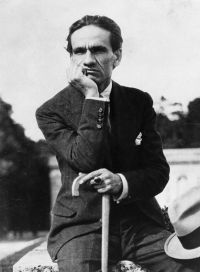
“ I feel good. Now a stoic ice shines in me. It makes me laugh this ruby rope grinding in my body. Rope without end, like a spiral descending from evil... bloody and left-handed rope formed by a thousand daggers in support. ”
Rope
Definition and stakes
A rope is a twisted or braided assembly of fibers, celebrated for its strength and versatility, fulfilling both practical and symbolic roles across cultures and eras. From César Vallejo’s metaphorical depiction of a “ruby rope” grinding within the body to Nehemiah Adams’s admiration for the “beauty of fitness” in a ship’s perfectly twisted strands, writers have explored its dual nature—as a tool of labor and a vehicle for poetic imagery.
Whether anchoring ships, enabling climbs, or embodying tension in literature, the rope unites physical utility with profound metaphorical resonance, reflecting humanity’s enduring dependence on its resilience and adaptability.
Quotes about “rope”
 Nehemiah Adams,
Under the mizzen mast: A voyage round the world
(1873)
Nehemiah Adams,
Under the mizzen mast: A voyage round the world
(1873)
“ I found my eye going up the new rope in admiration at the perfect regularity in the twist of the strands. An artist cannot always combine the hempen yarns with the exactness which the ropemaker’s wheel gives them. My eye went from the new rope to the old ones; all had the same perfect twist throughout the ship. The ropes, from belaying-pin to truck, the signal halyard and the hawser, seemed instinct with “the35 beauty of fitness,” to borrow a term from the above-mentioned writer,—a common window-sash, with its parallelograms of panes, serving that great genius for an illustration. ”
 Edward Carpenter,
From Adam's Peak to Elephanta
(1892)
Edward Carpenter,
From Adam's Peak to Elephanta
(1892)
“ He just puts a noose of rope round his two feet to enable him to grasp the stem better with his soles, clasps his hands round the trunk, brings his knees up to his ears, and shoots up like a frog swimming! ”
Various, The Strand Magazine (1892)
“ It was rope, and it gave way beneath my grasp. I caught at something again. It was a wheel and it turned round, but, as strange sounds, shouts, and cries reached my ears, I got hold of the cross beam, and somehow, by help of the wheel, managed to reach my old position, but crouching down and holding on for dear life. "Below there!" shouted a familiar voice, but hollow and strange, "who is it?" "I! Help! Help!" I gasped, now thoroughly unnerved. "Right; can you hold on till we send you down a rope?" ”
Mountain Craft (1920)
“ If we have fair room to balance, we play the rope [Pg 222] entirely free with our arms and the spring of our body, using only an anchor to the rock if we need it. If we have not room, and especially if we are protecting a leader, whose fall would jerk us off most positions of free balance, we put the rope over the point and play it round with both hands, ready to grip and spring it upon our arms if a jerk comes. Or we pass the active rope round our forearm or over the thigh or across the shoulder, on its way to the belay-point. ”
 George Allan England,
Pod Flits
(1909)
George Allan England,
Pod Flits
(1909)
“ And the erstwhile valiant one backed up with an exceeding meekness to a towering conifer. A minute later, the slight man had lashed him firmly to it with a hank of braided rope, thin rope but very strong. ”
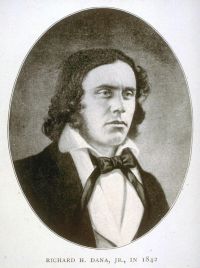 Richard Henry Dana,
Two Years Before the Mast — Chapter XXIV
Richard Henry Dana,
Two Years Before the Mast — Chapter XXIV
“ Having nothing on but shirt, trowsers, and hat, the common sea-rig of warm weather, I had no stripping to do, and began my descent, by taking hold of the rope in each hand, and slipping down, sometimes with hands and feet round the rope, and sometimes breasting off with one hand and foot against the precipice, and holding on to the rope with the other. ”
Edith Ballinger Price, The Happy Venture (1921)
“ In another second he had the frayed, wet end of rope in his hand. "That salvaged line!" he said. "Phil, couldn't you see that only her stern line was made fast? I left her half-moored till I came back. That rope was rotten, and it got jammed in here and chafed till it parted." ”
Nehemiah Adams,
Under the mizzen mast: A voyage round the world
(1873)
“ Moves all nature to gladness and mirth.” I cannot forget the simple pleasure which this meditation on a rope gave me, carrying me back to youthful days in my native place, and to the ropewalks there, the swift spindles, the horse in the cellar turning the wheel, the spinners, each with a bunch of hemp around him hitching it to the spindle, then walking backwards, paying out the hemp through his hands with judicious care, the rope all the time growing lengthwise, down the walk. ”
Homer Bezalee Hulbert, The passing of Korea (1906)
“ The impact of one coming down throws the other up into the air some three or four feet. A rope is drawn above their heads like a clothes-line, and to this they cling as they go up in the air, in order to insure their equilibrium. ”
Harold E. Cloke, The Gunner's Examiner
“ CORDAGE, BLOCKS, TACKLE, GINS, SHEARS, ETC.Q. Define yarn, strands, jaws of rope, short- and long-jawed rope, guys, spun-yarn, marlin, standing rigging, running rigging, and a bight.A. Yarn are called threads of hemp or other fibrous material which compose a rope.Strand is a number of yarns twisted together.Jaws of rope are the interstices between the strands of rope.Short-jawed rope is a rope tightly laid up together.Long-jawed rope is a rope loosely laid up together. [89] Guys are stationary ropes to hold spars, such as pry-poles, shears, etc., from falling. ”
Mountain Craft (1920)
“ With the rope half twisted round the free hand, which is drawing the rope out in front of the belay, we can apply, as between the tug of the arm behind and the ‘give’ of the hand in front, an efficient spring. ”
Mountain Craft (1920)
“ The last ten feet are the danger, for the short, swinging loose end may at any second jam or catch round the taut rope in its dance. To break any slight friction or hitch, and give the end of the rope a springing release from its belay, these last few feet should be rushed with a sharp continuous pull by two or more of the party, who must then look out for their heads! ”
Reuben Percy and Sholto Percy, The Percy Anecdotes (1820)
“ A common rope is stretched upon two pair of crossed spars, about twenty feet distant, and four- PASTIME. 101 teen feet from the ground. A man piies six water- pots upon his head, and thus accoutred, ascends the rope by means of the spars, or of a sloping cord on the outside of them; the rope is not quite tight, but left with a slack of about three feet; he then, with a balance pole in his hand, walks backward and forward, and swings the rope to its extent without letting a single pot fall. ”
Worthington Hooker, The Child's Book of Nature
“ It is a rope that he walks on like a rope-dancer; and you may sometimes see him swinging upon it. Sometimes, too, he lets himself down from some height, spinning the rope that holds him as he goes down. ”
H. R. Hall, History of Egypt, Chaldea, Syria…
“ A rope running over the spindle is fastened to the skin, while the funnel end of the skin is held up by a second rope, running over a lower spindle, until its mouth is opposite the trough into which the water is to be poured. ”
The story of rope (1916)
“ In his very earliest days man must have had something to serve for cords or lines,—strips of hide or of bark, pliant reeds and rushes, withes of tough woods, fibrous roots, hair of animals,—then, as the need arose for longer, larger and stronger lines, it was met, as human ingenuity developed, by twisting a number of some of these elements together and forming a rope or cord. ”
Mountain Craft (1920)
“ For the indirect belay we loop the active rope of the man climbing round a convenient point, and then make it our business to interpose our hands, arms, legs, shoulders, or any part of us which may prevent a jerk of his rope from coming uninterruptedly on to the solid rock. ”
Various, The Southern Literary Messenger…
“ Nature, in her exuberant goodness, has supplied an abundance of primitive rope, which is just as convenient and efficacious as the best cordage, whether a man wants to hang himself or a dog—whether he wants a cap for his fence, a backband for his plough-horse, a pair of leading lines, or a girth for his saddle. ”
“ Through the hole in the other end a piece of rope eighteen inches long is passed and knotted as in the first end, in such a way that the loose end of the rope, which is to be fastened to the kid's leg, draws away from the stake. ”
Mountain Craft (1920)
“ The rope should be examined after every ascent, and at intervals during the day, for bruises or frayed strands. A single frayed strand justifies the cutting or rejecting of the rope. An old rope should never be used. ”
Frank A. Martin, Under the absolute Amir (1907)
“ The rope is a country-made one of unequal thickness, and ragged with loose strands, and has a good deal of stress thrown on it by the swift current which surges against the raft, and swings it from side to side on its passage, and it struck me that a passenger addicted to nerves would find the crossing a rather trying time. ”
Robert Moreton, On horse-breaking (1877)
“ Having reached the mane, pay the rope out slowly between your fingers, so that it will fall on the off side of the neck; when about eighteen inches to a couple of feet have been worked out through your fingers, you will see the end of the rope hanging down under the neck on the off side. ”
 Arnold Henry Savage Landor,
In the forbidden land
(1898)
Arnold Henry Savage Landor,
In the forbidden land
(1898)
“ This done, they passed the rope through a hole in the top of a high post behind me, and by tugging at it, strained my arms upwards in a way that, had I been less supple, would certainly have broken them. When all their strength combined could not stretch me another inch without tearing my body to pieces, they made the rope fast, and I remained half suspended, and feeling as if all the bones of my limbs were getting, or had got, pulled out of their sockets. ”
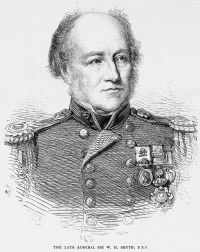 W. H. Smyth,
The Sailor's Word-Book
W. H. Smyth,
The Sailor's Word-Book
“ GURNET-PENDANT. A rope, the thimble of which is hooked to the quarter-tackle of the main-yard; it is led through a hole in the deck, for the purpose of raising the breech of a gun, when hoisting in, to the level required to place it on its carriage. ”
Various, Harper's New Monthly Magazine, No…
“ This rope will act as a drag on the balloon, when, from any of the causes we have referred to, it tends to rise, for, in that case, it will draw up a portion of the rope, and, by thus adding to its weight, will be impeded in its upward course; and, on the other hand, when, from opposite causes, it tends to descend, it will, during every foot of its descent, have its weight, and consequently its descending tendency, diminished, by throwing on the earth the labor of supporting an additional portion of the rope. ”
 George Bird Grinnell,
Jack the Young Cowboy: An Eastern Boy's Experiance on a Western Round-up
George Bird Grinnell,
Jack the Young Cowboy: An Eastern Boy's Experiance on a Western Round-up
“ Often the man who was holding the end of the rope, seeing a horse about to push under, would slacken the rope until it was under the pony's nose, and then, giving the rope a quick jerk, it would spring up and hit the horse, making him throw up his head. ”
 Samuel Hopkins Adams,
The Secret of Lonesome Cove — Chapter XIX. The Strange Tryst
(1912)
Samuel Hopkins Adams,
The Secret of Lonesome Cove — Chapter XIX. The Strange Tryst
(1912)
“ It was this gray-white rope, sort of clothes-line, and it looked strong.“‘What now?’ I asked her.“‘To bind us together,’ she said. ‘Close, close together, and then the plunge! This time there shall be no failure. They shall not find one of us without the other. ”
“ Thus rope making may be seen to consist in a series of twisting processes, each twist opposite to the former, the rope growing in size and strength at each operation. Horse power or water power was used when the ropes became too large to be made by hand. ”
Mountain Craft (1920)
“ We make the distinction between an ‘anchor,’ the loop of inactive rope with which a stationary climber secures himself to a rock point, in order to protect himself and the rest of the party while somebody else is climbing, and a ‘belay,’ which is the rock-and-rope attachment by which the active rope of a moving man is protected while it is running out or being pulled in. ”
Every Boy's Book: A Complete Encyclopædia of Sports and Amusements
“ In climbing the rope, it is firmly grasped by the hands, which are placed one above the other, and so moved alternately. The heels are crossed over the rope, which is held fast by their pressure, the body being supported principally by them. ”
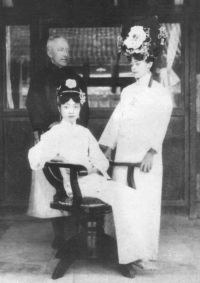 Sir Reginald Fleming Johnston,
From Peking to Mandalay
Sir Reginald Fleming Johnston,
From Peking to Mandalay
“ In view of the fact that we were all novices at rope-climbing, each of us submitted, before starting, to having a leather thong tied under the arms, and made fast to the sliding cylinder, so that if loss of nerve or other cause had made us let go we should not have fallen into the river, but hung limply on the rope until rescued. ”
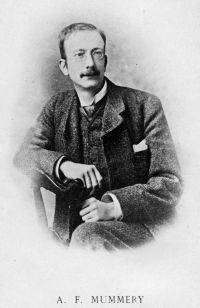 Albert Frederick Mummery,
My Climbs in the Alps and Caucasus
(1895)
Albert Frederick Mummery,
My Climbs in the Alps and Caucasus
(1895)
“ Arrived at this point, where the ropes will have cut deep into the snow, the engulfed man has only to rest his whole weight on the rope round his waist, and he can then jerk the other rope free from the snow, and get fresh hold higher up, and, little by little, extricate himself. ”
Robert Folkestone Williams, Lady Eureka; or, The Mystery: A Prophecy of the Future…
“ They immediately threw a thick rope across the chasm, which was made fast to a neighbouring tree—another rope was fastened within a foot of it—over these, two strong hoops were sent across, connected with each other, and affixed to a strong rope, and by resting the body within these, and holding the ropes by the arms, each individual of the party was dragged in safety to the other side of the rock. ”
Mountain Craft (1920)
“ If there is no corner to help, we must lean the whole weight of our body upon the rope where it runs out to us round the belay on our axe; so crushing the racing rope into the snow and reducing the final tug upon the driven axe shaft. ”
 Clive Phillipps-Wolley,
Big Game Shooting, volume 2 (of 2…
Clive Phillipps-Wolley,
Big Game Shooting, volume 2 (of 2…
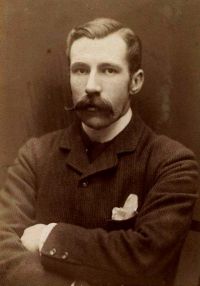
“ With these, cinches, sling ropes, halter ropes, and a good supply of spare rope of the kinds known respectively as half-and quarter-inch, the sportsman should be able to transport all he requires through almost any country. ”
J. S. Rarey, A New Illustrated Edition of J. S. Rarey's Art of Taming Horses
“ The observations about rope halters are very sound, and in addition I may add, that the mouths of hundreds of horses are spoiled by the practice of passing a looped rope round the lower jaw of a fiery horse, which the rider often makes the stay for keeping himself in his seat. ”
Tomás de Comyn, The Former Philippines Thru Foreign Eyes
“ We could then perceive a rope fast to each leg of the sufferer, which was pulled with violence by people under the gallows, and an additional rope, to use a sea term, a preventer, was round his neck, and secured to the gallows, to act in case of accident to the one by which the body was suspended. ”
| editor, Oregon Historical Quarterly (1915)
“ Many times the rope would catch against the rocks and oblige someone to crawl carefully over the horrible precipice to unloosen it, much to the danger of his life. When my husband came up, in passing this place, the rope caught in a place so difficult of access that no one would venture his life to extricate it, for some time. ”
Robert Wood Williamson, The Mafulu: Mountain People of British New Guinea
“ Boys, and men also, play at tug-of-war, using long canes for ropes; and boys and girls have swings, constructed either by looping two flexible rope-like tree stems together at the bottom, or with a single rope, with a loop at the bottom, in which to place their feet. ”
W. H. Smyth,
The Sailor's Word-Book
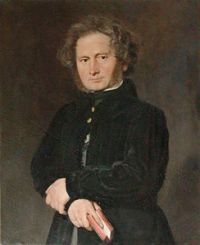
“ HAWSER-LAID ROPE. Is rope made in the usual way, being three or four strands of yarns laid up right-handed, or with the sun; it is used for small running rigging, as well as for standing rigging, shrouds, &c.; in the latter case it is generally tarred to keep out rain. It is supposed that this style of rope is stronger in proportion to the number of yarns than cable or water-laid rope, which is more tightly twisted, each strand being a small rope. ”
 Johann David Wyss,
The Swiss Family Robinson - 1851
(1851)
Johann David Wyss,
The Swiss Family Robinson - 1851
(1851)
“ If they wish to capture an animal, they hurl one of the stones at it with singular address. By the peculiar art with which the ball is thrown, the rope makes a turn or two round the neck of the animal, which remains entangled, without the power of escaping. ”
Sven Anders Hedin, Trans-Himalaya: Discoveries and Adventurers in Tibet…
“ The free end of the rope forms a noose above the ring of fibres, which tightens when the animal first attempts to lift his leg and holds down the funnel of ribs. The more the poor animal jumps about, the faster is the hold of the twisted snare. ”
Mountain Craft (1920)
“ The last man on the rope, when all are moving together in ascent or descent, has a special obligation to give this timely warning, since no one has him in view. The instant he hears the warning or the scrape on the rock, every man braces his muscles, and, if possible, anchors his rope. A practised ear distinguishes at once between the ordinary clean scrape of a climbing boot and the scuffled scrape of a slip, or the snap of a breaking handhold. ”
Homer J. Dana, The Use of Ropes and Tackle
“ In the use of ropes, occasion arises, many times, where it is necessary to join two ends together in such a way that the union is as strong as the rest of the rope and still not too large or irregular to pass through a hole or pulley block. ”
Mountain Craft (1920)
“ The rope must be snatched in as he falls, round the belay or loose in the hands. If the fall is from our own level, or from only diagonally above us, we can tighten the rope at once, and this serves to give a sideways tug to the man falling, which lessens the force of the final jerk as he swings in below us. ”
Harold E. Cloke, The Gunner's Examiner
“ The bight of a rope is any part not an end.A bight of a rope is formed by bending or doubling the rope so as to form a loop.Standing rigging are those ropes which are stationary.Running rigging are those which run through blocks or pulleys. (See Figs. 45 and 46.) Q. Explain the difference between hawser-laid rope and cable-laid rope.A. Cable-laid rope is composed of nine strands, and is made by first laying up three ropes of three strands each with the sun, and then laying the three ropes together into one, against the sun. Hawser-laid rope must be coiled with the sun. ”
Related terms
Authors who wrote about “rope”
W. H. SmythHomer J. DanaCaptain JutsumHarold E. ClokeAlbert Frederick MummeryThomas Baines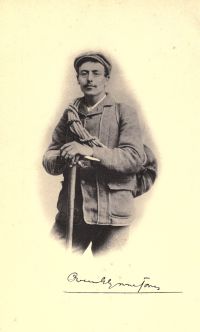 Owen Glynne Jones
 William FalconerRichard Henry DanaWilliam Ernest Dalby
 Francis GaltonCharles Sumner SeeleyGeorge Bird GrinnellVarious
 Arthur Oliver WheelerNehemiah Adams
 James George Frazer
 Joseph Strutt
 Lewis CarrollRobert Wood Williamson