Summary

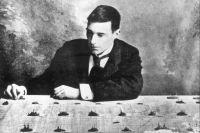
Portrait of Fred T. Jane Fred T. Jane The imperial Japanese navy

If one is explaining anything to a Japanese, he will have seized on the idea and absorbed it while a European is still struggling with the externals of it. Japanese invention has extended to a small quickfirer and a water-tube boiler, but in both cases the invention is merely a change of some existing mechanism. Even so, neither is of great moment; their abilities do not lie in that direction at all. If an entirely new system of naval tactics is ever evolved, it will not be by a Japanese; like their British confrères, they shine better at practical work than in the regions of theory.
Source: Gutenberg

Portrait of Fred T. Jane Fred T. Jane The imperial Japanese navy

Such are Japanese naval officers. To sum up, they have little ambition, little thirst for personal glory, but a good deal of thirst for the thunder of battle. The only religion that they wot of is the worship of their fleet; their only heaven, that fleet in action. They cannot originate, but they are peerless at practising the things that they have learnt. And there is only one possible way of beating a Japanese fleet—by sinking it.
In many of these things the trail of Samaurai may be visible. The Samaurai were trained to kill and to be killed
Source: Gutenberg

Portrait of Fred T. Jane Fred T. Jane The imperial Japanese navy

Not invariably, of course, still there is, I fancy, a fair sprinkling of lieutenants who devote as much or more thought to an admiral’s duty twenty years hence than to lieutenant work of to-day. It is not, primarily, a bad thing so much as a good thing overdone; but that is a Japanese naval characteristic all through. They are always in more danger of overdoing a good thing than anything else. Curiously enough, this tendency to think for the admiral does not lead to any great evil in the way of an undue corresponding tendency to be critical.
Source: Gutenberg

Get perspective with Kwize: daily news enlightened by great literature