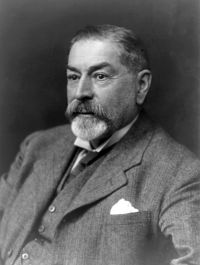
Frederick Orpen Bower

Frederick Orpen Bower

Summary

Portrait of Frederick Orpen Bower Frederick Orpen Bower 1911 Encyclopædia Britannica, Volume 13… (1911)

The conclusions of Hofmeister remain in their broad outlines unshaken, but rather strengthened by later-acquired details. In the light of the theory of descent the common plan of life-history in plants apparently so diverse as those named acquires a special significance; but it is one of the remarkable features of this great work that the writer himself does not theorize—with an unerring insight he points out his comparisons and states his homologies, but does not indulge in explanatory surmises. It is the typical work of an heroic age of plant-morphology.
Source: Wikisource

Portrait of Frederick Orpen Bower Frederick Orpen Bower 1911 Encyclopædia Britannica, Volume 13… (1911)

His first work was on the distribution of the Coniferae in the Himalaya, but his attention was very soon devoted to studying the sexuality and origin of the embryo of Phanerogams. His contributions on this subject extended from 1847 till 1860, and they finally settled the question of the origin of the embryo from an ovum, as against the prevalent pollen-tube theory of M. J. Schleiden, for he showed that the pollen-tube does not itself produce the embryo, but only stimulates the ovum already present in the ovule.
Source: Wikisource

Portrait of Frederick Orpen Bower Frederick Orpen Bower 1911 Encyclopædia Britannica, Volume 13… (1911)

Hofmeister transferred the discussion from the mere study of mature form to the observation of the development of the parts, and substituted for the “spiral tendency” a mechanical theory based upon the observed fact that new branchings appear over the widest gaps which exist between next older branchings of like nature. With this important work Hofmeister’s period of active production closed
Source: Wikisource

Get perspective with Kwize: daily news enlightened by great literature