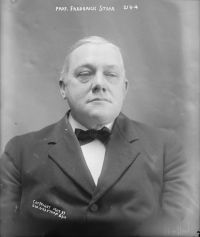
Frederick Starr

Frederick Starr

Summary

Portrait of Frederick Starr Frederick Starr,  Aztec place-names

“ When two nouns only are compounded into a place-name, the first loses its final letters or last syllable, while the second remains entire. The first is a qualifier of the second and follows it in translation, e. g.—Tecalli from tetl, calli = “house (calli) of stone (tetl) .”
8. In place-names compounded of an adjective and a noun, the adjective precedes, e. g.—Iztacuauhtli from iztac, cuauhtli = “the white (iztac) eagle (cuauhtli) .”
”
Source: Gutenberg

Portrait of Frederick Starr Frederick Starr,  Aztec place-names

“ Teocuitlatlan. [Where there is gold.] Compounded of teocuitlatl (gold—i.e., divine excrement, from teotl, god and cuitlatl, excrement) ; tlan (place of) .
Teochiapan. [Where is the sacred chia.] Compounded of teotl (god, hence sacred or dedicated to religion) ; chia (a species of salvia) ; pan (place) .
Teonochtitlan. [Where there are sacred nopalli i.e., nopals, or cacti belonging to temple properties.] Compounded of teotl (god) ; nochtli, a cactus; ti, a euphonic particle; tlan (place) .
”
Source: Gutenberg

Portrait of Frederick Starr Frederick Starr,  Aztec place-names

“ No words are more interesting or suggestive in this direction than geographical names. This is particularly true because the hieroglyphic material most conveniently accessible to the student chances to be a list of place-names. The method of study we borrow from de la Rosa’s little work Explicacion de algunos de los Nombres de la Lengua Mexicana. His mode of analysis and presentation is direct and simple. De la Rosa’s arrangement has been followed in detail. The name is first presented in full; the meaning is then given in bracketed print ”
Source: Gutenberg

Get perspective with Kwize: daily news enlightened by great literature