Summary

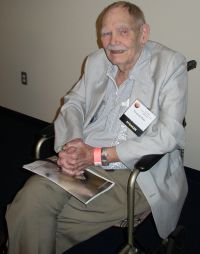
Portrait of Frederik Pohl Frederik Pohl The Tunnel Under the World

Burckhardt said, "Come on." Swanson reluctantly followed him through the tangled aisles of stainless steel columns and tanks.
They walked as though they were in the presence of the dead. In a way, they were, for what were the automatons that once had run the factory, if not corpses? The machines were controlled by computers that were really not computers at all, but the electronic analogues of living brains. And if they were turned off, were they not dead? For each had once been a human mind.
Take a master petroleum chemist, infinitely skilled in the separation of crude oil into its fractions.
Source: Gutenberg

Portrait of Frederik Pohl Frederik Pohl The Tunnel Under the World

Swanson didn't even acknowledge the greeting. He merely sighed a very deep sigh.
"Nothing doing," he mumbled, apparently to himself. He nodded abstractedly to Burckhardt and turned away.
Burckhardt watched the slumped shoulders disappear in the crowd. It was an odd sort of day, he thought, and one he didn't much like. Things weren't going right.
Riding home on the next bus, he brooded about it. It wasn't anything terrible or disastrous; it was something out of his experience entirely. You live your life, like any man, and you form a network of impressions and reactions. You expect things.
Source: Gutenberg

Portrait of Frederik Pohl Frederik Pohl The Tunnel Under the World

It isn't the things that are right and perfect in your life that make it familiar. It is the things that are just a little bit wrong—the sticking latch, the light switch at the head of the stairs that needs an extra push because the spring is old and weak, the rug that unfailingly skids underfoot.
It wasn't just that things were wrong with the pattern of Burckhardt's life; it was that the wrong things were wrong. For instance, Barth hadn't come into the office, yet Barth always came in.
Source: Gutenberg

Get perspective with Kwize: daily news enlightened by great literature