Summary

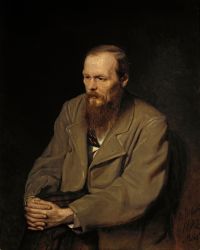
Portrait of Fyodor Dostoevsky Fyodor Dostoevsky The Brothers Karamazov — Part I, Book II, Chapter 5 (1880)

And there can be no doubt that the Church would look upon the criminal and the crime of the future in many cases quite differently and would succeed in restoring the excluded, in restraining those who plan evil, and in regenerating the fallen. It is true," said Father Zossima, with a smile, "the Christian society now is not ready and is only resting on some seven righteous men, but as they are never lacking, it will continue still unshaken in expectation of its complete transformation from a society almost heathen in character into a single universal and all-powerful Church.
Source: Wikisource

Portrait of Fyodor Dostoevsky Fyodor Dostoevsky The Brothers Karamazov — Part I, Book II, Chapter 5 (1880)

Miusov glanced keenly at him.
"If everything became the Church, the Church would exclude all the criminal and disobedient, and would not cut off their heads," Ivan went on. "I ask you, what would become of the excluded? He would be cut off then not only from men, as now, but from Christ. By his crime he would have transgressed not only against men but against the Church of Christ.
Source: Wikisource

Portrait of Fyodor Dostoevsky Fyodor Dostoevsky The Brothers Karamazov — Part I, Book II, Chapter 5 (1880)

As for Rome, it was proclaimed a State instead of a Church a thousand years ago. And so the criminal is no longer conscious of being a member of the Church and sinks into despair. If he returns to society, often it is with such hatred that society itself instinctively cuts him off. You can judge for yourself how it must end. In many cases it would seem to be the same with us, but the difference is that besides the established law courts we have the Church too, which always keeps up relations with the criminal as a dear and still precious son.
Source: Wikisource

Get perspective with Kwize: daily news enlightened by great literature