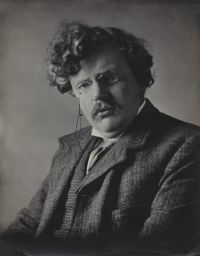
Gilbert Keith Chesterton

Gilbert Keith Chesterton

Summary

Portrait of Gilbert Keith Chesterton Gilbert Keith Chesterton The Apostle and the Wild Ducks… (1975)

Politeness is thus a thing mysterious and elemental, going down to the foundations of the world. Since no man can express how surprising and terrifying and beautiful is every object upon which we gaze, on the day when we all become truly primitive we shall all become extravagantly polite; we shall take off our hats to the sparrows, and apologise for treading on the daisies. Politeness of this kind is simply imagination.
Source: Wikisource

Portrait of Gilbert Keith Chesterton Gilbert Keith Chesterton The Apostle and the Wild Ducks… (1975)

Uneducated people, that is to say, have no manners, educated people have bad manners.
Nobody can visit the House of Commons without coming away with the general impression that the art cultivated by the young country gentleman is the art of doing his worst elegantly; and to do one's worst, however elegantly, remains what it is, the one and solitary supreme insult. If a man throws his worst or his tenth best to anything, it matters nothing if the thing he throws be the Iliad or a casket of sapphires, it still remains an insult.
Source: Wikisource

Portrait of Gilbert Keith Chesterton Gilbert Keith Chesterton The Apostle and the Wild Ducks… (1975)

But the difference between no manners and bad manners is quite as definite and important as the difference between no eggs and bad eggs.
The absence of manners is an unconscious and chaotic thing, the product of vagueness, of monomania, of absence of mind, of ignorance of the world. But the presence of bad manners is a perfectly solemn, deliberate, and artificial thing, the result of pride and vainglory, hypocrisy and blindness and hardness of heart. A great mass of human society may thus be simply and satisfactorily divided into two definite sections.
Source: Wikisource

Get perspective with Kwize: daily news enlightened by great literature