Summary

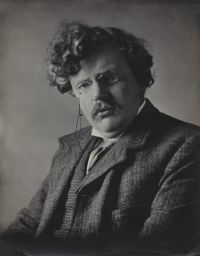
Portrait of Gilbert Keith Chesterton Gilbert Keith Chesterton The Ball and the Cross — XII: The Desert Island (1909)

Then we could leave one copy on the island whatever happens to us and put another in an empty bottle and send it out to sea, as they do in the books."
"A good idea," said Turnbull, "and now let us finish unpacking."
As MacIan, a tall, almost ghostly figure, paced along the edge of sand that ran round the islet, the purple but cloudy poetry which was his native element was piled up at its thickest upon his soul. The unique island and the endless sea emphasized the thing solely as an epic.
Source: Wikisource

Portrait of Gilbert Keith Chesterton Gilbert Keith Chesterton The Ball and the Cross — XII: The Desert Island (1909)

They did not even explore the island; for MacIan was partly concerned in prayer and Turnbull entirely concerned with tobacco; and both these forms of inspiration can be enjoyed by the secluded and even the sedentary. It was on a golden afternoon, the sun sinking over the sea, rayed like the very head of Apollo, when Turnbull tossed off the last half-pint from the emptied Wilkinsonian bottle, hurled the bottle into the sea with objectless energy, and went up to where his sword stood waiting for him on the hill.
Source: Wikisource

Portrait of Gilbert Keith Chesterton Gilbert Keith Chesterton The Ball and the Cross — XII: The Desert Island (1909)

Evan MacIan coming bounding back across the sand-heaps breathless, without his cap and keeping the sword in his hand only by a habit now quite hardened.
"Take care, Turnbull," he cried out from a good distance as he ran, "I've seen a native."
"A native?" repeated his companion, whose scenery had of late been chiefly of shellfish, "what the deuce! Do you mean an oyster?"
"No," said MacIan, stopping and breathing hard, "I mean a savage. A black man."
Source: Wikisource

Get perspective with Kwize: daily news enlightened by great literature