Summary

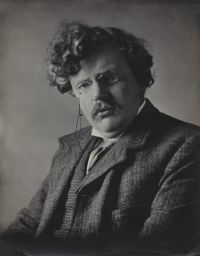
Portrait of Gilbert Keith Chesterton Gilbert Keith Chesterton The Napoleon of Notting Hill — Book III, Chapter II (1904)

I see blank well-ordered streets, and men in black moving about inoffensively, sullenly. It goes on day after day, day after day, and nothing happens; but to me it is like a dream from which I might awake screaming. To me the straightness of our life is the straightness of a thin cord stretched tight. Its stillness is terrible. It might snap with a noise like thunder. And you who sit, amid the débris of the great wars, you who sit, as it were, upon a battlefield, you know that war was less terrible than this evil peace
Source: Wikisource

Portrait of Gilbert Keith Chesterton Gilbert Keith Chesterton The Napoleon of Notting Hill — Book III, Chapter II (1904)

Turnbull enjoyed it partly as a joke, even more perhaps as a reversion from the things he hated—modernity and monotony and civilization. To break up the vast machinery of modern life and use the fragments as engines of war, to make the barricade of omnibuses and points of vantage of chimneypots, was to him a game worth infinite risk and trouble. He had that rational and deliberate preference which will always to the end trouble the peace of the world, the rational and deliberate preference for a short life and a merry one.
Source: Wikisource

Portrait of Gilbert Keith Chesterton Gilbert Keith Chesterton The Napoleon of Notting Hill — Book III, Chapter II (1904)

But do you keep only, sir, the symbols of this prehistoric sanity, this childish rationality of the earth? Do you not keep more terrible things? What are those boxes, seemingly of lead soldiers, that I see in that glass case? Are they not witnesses to that terror and beauty, that desire for a lovely death, which could not be excluded even from the immortality of Eden? Do not despise the lead soldiers, Mr. Turnbull."
"I don't," said Mr. Turnbull, of the toy-shop, shortly, but with great emphasis.
"I am glad to hear it," replied Wayne.
Source: Wikisource

Get perspective with Kwize: daily news enlightened by great literature