Summary

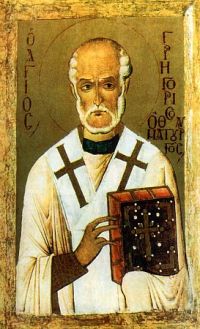
Portrait of Gregory Thaumaturgus Gregory Thaumaturgus Ante-Nicene Fathers Vol. VI, Dubious or Spurious Writings… (1885)

How, indeed, could it be possible for man, who is limited on six sides—by east, west, south, north, deep, and sky—understand a matter which is above the skies, which is beneath the deeps, which stretches beyond the north and south, and which is present in every place, and fills all vacuity? But if, indeed, we are able to scrutinize spiritual substance, its excellence truly would be undone.
Source: Wikisource

Portrait of Gregory Thaumaturgus Gregory Thaumaturgus Ante-Nicene Fathers Vol. VI, Dubious or Spurious Writings… (1885)

But the Word of God is substantial, endowed with an exalted and enduring nature, and is eternal with Himself, and is inseparable from Him, and can never fall away, but shall remain in an everlasting union. This Word created heaven and earth, and in Him were all things made. He is the arm and the power of God, never to be separated from the Father, in virtue of an indivisible nature, and, together with the Father, He is without beginning. This Word took our substance of the Virgin Mary; and in so far as He is spiritual indeed, He is indivisibly equal with the Father
Source: Wikisource

Portrait of Gregory Thaumaturgus Gregory Thaumaturgus Ante-Nicene Fathers Vol. VI, Dubious or Spurious Writings… (1885)

Again, the denomination of man is not in actual fact a denomination, but a substance common to men, and is the denomination proper to all men. Moreover, names are such as these,—Adam, Abraham, Isaac, Jacob: these, I say, are names. But the Divine Persons are names indeed: and the names are still the persons; and the persons then signify that which is and subsists,—which is the essence of God. The name also of the nature signifies subsistence; [3] as if we should speak of the man. All (the persons) are one nature, one essence, one will, and are called the Holy Trinity
Source: Wikisource

Get perspective with Kwize: daily news enlightened by great literature