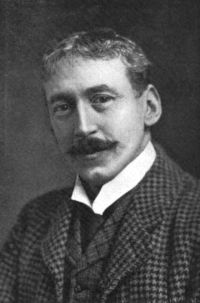
H. De Vere Stacpoole

H. De Vere Stacpoole

Summary

Portrait of H. De Vere Stacpoole H. De Vere Stacpoole A Primal Woman (1919)

At the end of a year Jourdain had proved Lygon and found him trustworthy, and he raised his position to an equal partnership with an equal share in the business.
“I have no relations,” said Jourdain, “no one but Kineia and you. Captain Morris of my schooner is a good man, but he is almost a stranger to me, though I have known him some years—some men are like that; one never gets to know them beyond a certain point. You have become to me almost as a relation. When I am dead, if we go on as we are going, perhaps you will have the whole business.”
Source: Gutenberg

Portrait of H. De Vere Stacpoole H. De Vere Stacpoole A Primal Woman (1919)

The Sarah Dodsley had run out of wood, that was why Captain Sellers had brought her up to Utara, but he had no intention of entering the lagoon. He hove to outside the reef and ordered three boats away, under the direction of the first mate.
Lygon was in the mate’s boat.
They found the break in the reef and entered the lagoon on the swell of the incoming tide. The level rays of the newly risen sun lit the white beach down to which trooped the trees—breadfruit and pendanus, artus and cocoa palms—overshot with flights of colored birds and whispered to by the morning wind.
Source: Wikisource

Portrait of H. De Vere Stacpoole H. De Vere Stacpoole A Primal Woman (1919)

Now when a white man marries an island woman he marries a woman with a past, a being with an ancestry as remote from his as Sirius from Rigel. Nalia, the wife of Captain Jourdain, and the mother of Kineia, a tender-eyed, gentle, soft-voiced woman, had exhibited this fact once in a flash. A ruffian named Havermuth, who had been fired off a ship and had become at once the beach comber and terror of the island, had gone for Jourdain with intent to kill.
Source: Gutenberg

Get perspective with Kwize: daily news enlightened by great literature