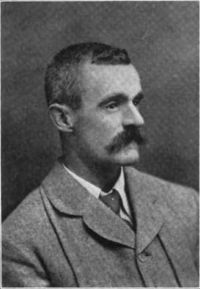
Harold Edward Bindloss

Harold Edward Bindloss

Summary

Portrait of Harold Edward Bindloss Harold Edward Bindloss The Gold Trail — Chapter II (1910)

Sometimes it flashed under dazzling sunshine, but at least as often they moved through the dim shadow of towering pines that rolled, rank on rank, somber and stately, up the steep hillside, while high above them all rose tremendous ramparts of eternal snow. Then, as the sun dipped behind the great mountain wall, the clean, aromatic fragrance of pine and fir and cedar crept into the cooling air, and a stillness so deep that it became almost oppressive descended upon the lonely valley.
Source: Wikisource

Portrait of Harold Edward Bindloss Harold Edward Bindloss The Gold Trail — Chapter II (1910)

The Packer Weston was engaged with several others flinging gravel into a flat car with a long-hafted shovel the next morning when Cassidy strode up the track; and, though the men already had been working hard, they quickened the pace a little when they saw him. He could tell at a glance whether a man were doing his utmost, and nothing less would satisfy him. He knew also exactly how many cubic yards of soil or gravel could be handled by any particular gang.
Source: Wikisource

Portrait of Harold Edward Bindloss Harold Edward Bindloss The Gold Trail — Chapter II (1910)

The smaller ranchers are as a rule adept at it, and when it is necessary, as it sometimes is, will cheerfully walk over a mountain range with a big sack of flour or other sundries bound upon their shoulders. Four or five leagues is not considered too great a distance to pack a bushel or two of seed potatoes, or even a table for the ranch, and Weston, who had reasons for being aware that work of the kind is at least as arduous as shoveling gravel, did not feel greatly tempted by the offer. Cassidy seemed to guess what he was thinking.
Source: Wikisource

Get perspective with Kwize: daily news enlightened by great literature