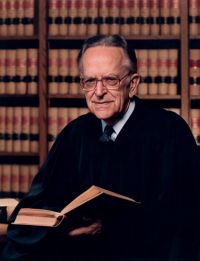
 Harry Blackmun,
Brendale v. Confederated Tribes and Bands of the Yakima Indian Nation…
(1989)
Harry Blackmun,
Brendale v. Confederated Tribes and Bands of the Yakima Indian Nation…
(1989)
“ While Justice WHITE's opinion misreads the Court's decisions defining the limits of inherent tribal sovereignty, Justice STEVENS' opinion disregards those decisions altogether. By grounding the Tribe's authority to zone non-Indian fee lands exclusively in its power to exclude non-Indians from the reservation, and by refusing even to consider whether the Tribe's inherent authority might support the zoning of non-Indian fee lands in the "open area," Justice STEVENS' opinion appears implicitly to conclude that tribes have no inherent authority over non-Indians on reservation lands. ”
