Summary

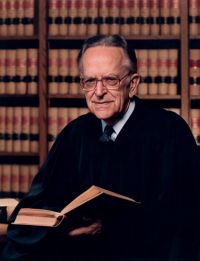
Portrait of Harry Blackmun Harry Blackmun Sierra Club v. Morton — Dissenting Opinion

Alternatively, I would permit an imaginative expansion of our traditional concepts of standing in order to enable an organization such as the Sierra Club, possessed, as it is, of pertinent, bona fide, and well recognized attributes and purposes in the area of environment, to litigate environmental issues. This incursion upon tradition need not be very extensive. Certainly, it should be no cause for alarm. It is no more progressive than was the decision in Data Processing itself. It need only recognize the interest of one who has a provable, [p758] sincere, dedicated, and established status.
Source: Wikisource

Portrait of Harry Blackmun Harry Blackmun Sierra Club v. Morton — Dissenting Opinion

I would be willing to do this on condition that the Sierra Club forthwith amend its complaint to meet the [p757] specifications the Court prescribes for standing. If Sierra Club fails or refuses to take that step, so be it; the case will then collapse. But if it does amend, the merits will be before the trial court once again. As the Court, ante at 405 U. S. 730 n. 2, so clearly reveals, the issues on the merits are substantial, and deserve resolution. They assay new ground. They are crucial to the future of Mineral King.
Source: Wikisource

Portrait of Harry Blackmun Harry Blackmun Sierra Club v. Morton — Dissenting Opinion

If we assume that the 14,000 daily visitors come by automobile (rather than by helicopter or bus or other known or unknown means) and that each visiting automobile carries four passengers (an assumption, I am [p759] sure, that is far too optimistic) , those 14,000 visitors will move in 3,500 vehicles. If we confine their movement (as I think we properly may for this mountain area) to 12 hours out of the daily 24, the 3,500 automobiles will pass any given point on the two-lane road at the rate of about 300 per hour.
Source: Wikisource

Get perspective with Kwize: daily news enlightened by great literature