Summary

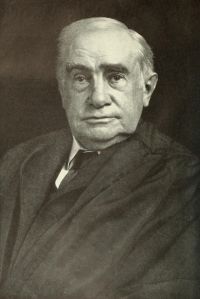
Portrait of Henry Billings Brown Henry Billings Brown Davis v. Wakelee — Opinion of the Court

It is contrary to the first principles of justice that a man should obtain an advantage over his adversary by asserting and relying upon the validity of a judgment against himself, and in a subsequent proceeding upon such judgment claim that it was rendered without personal service upon him. Davis may possibly have been mastaken in his conclusion that the judgment was valid, but he is conclusively presumed to know the law, and cannot thus speculate upon his possible ignorance of it.
Source: Wikisource

Portrait of Henry Billings Brown Henry Billings Brown Davis v. Wakelee — Opinion of the Court

In the uncertainty which appears to exist in that state as to whether a complaint setting forth all the facts would or would not be demurrable, we think it may be fairly said that the remedy at law is not so plain or clear as to oust a court of equity of jurisdiction. It is a settled principle of equity jurisprudence that, if the remedy at law be doubtful, a court of equity will not decline cognizance of the suit.
Source: Wikisource

Portrait of Henry Billings Brown Henry Billings Brown Davis v. Wakelee — Opinion of the Court

While our attention has not been called to any case wherein a bill has been sustained in favor of a plaintiff in a proposed action at law to enjoin the defendant from setting up a threatened defense upon the ground that he is equitably estopped from so doing, we know of no good reason why he should not be permitted to do so, unless his remedy at law be plain, adequate, and complete.
Source: Wikisource

Get perspective with Kwize: daily news enlightened by great literature