Summary

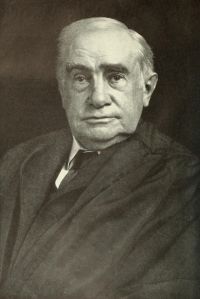
Portrait of Henry Billings Brown Henry Billings Brown Derby v. Thompson — Opinion of the Court

A catch or fastening device which keeps this bail in place when the chair is used as a high chair.
If Mr. Kenna had been the first to invent a high chair which, by a simple mechanical arrangement, could be converted into a rolling chair or carriage by the aid of a bail which served alternately for the support of the high chair and as a push handle for the rolling chair, his patent would doubtless be entitled to a liberal construction. Such a device is at once ingenious, useful, compact, and convenient.
Source: Wikisource

Portrait of Henry Billings Brown Henry Billings Brown Derby v. Thompson — Opinion of the Court

It is pertinent to remark in this connection, as bearing upon the merits of this patent, that the invention described in it never seems to have gone into use, perhaps owing to the fact that the chair was incumbered by a slotted bar, G, which was necessary, when used as a high chair to prevent it from tilting forward on its pivots, and throwing the child out. Plaintiff's chair, as constructed and put upon the market, not only dispenses with the catch, F, but locates the wheels upon the front legs of the supplemental frame, much as in the Caulier and Pearl chairs.
Source: Wikisource

Portrait of Henry Billings Brown Henry Billings Brown Derby v. Thompson — Opinion of the Court

In these devices the frame, A, is not pivoted to the chair frame, but is hinged to it in such a manner that the chair cannot tip forward, and hence the slotted bars (which, though not claimed, are an essential feature of the Kenna device) are unnecessary. Neither of the exhibits put in evidence as the defendant's chair has the yielding rest or support, F. It is true that, by a slight elasticity in the bail, it is made to catch under the frame of the chair seat in such manner as to obviate the necessity of a rest or support.
Source: Wikisource

Get perspective with Kwize: daily news enlightened by great literature